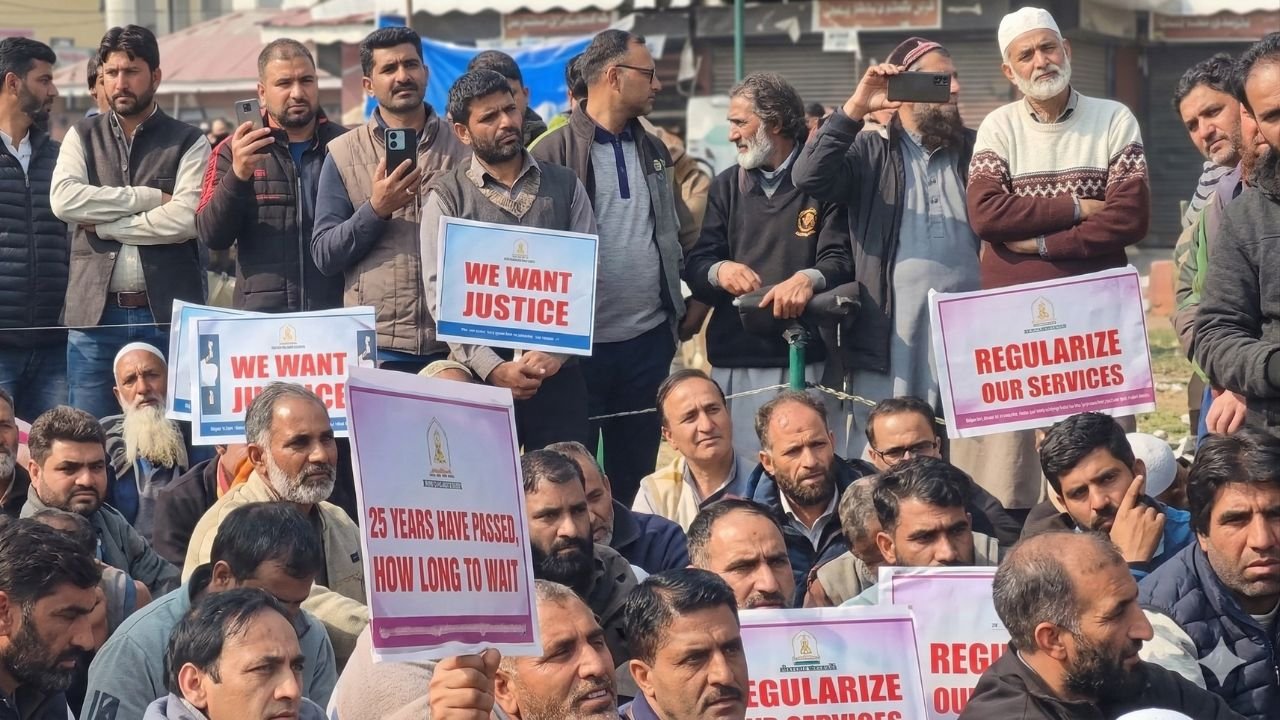
For thousands of daily wagers and casual labourers working across Jammu & Kashmir’s government departments, a long wait may finally be nearing its end. Chief Minister Omar Abdullah has made a firm commitment on the floor of the Legislative Assembly: the regularisation of daily wagers will begin this fiscal year — in a phased, structured, and fair manner.
What happened in the Assembly?
The debate was sparked by a Private Member’s Bill tabled by veteran CPI(M) MLA MY Tarigami, which sought the formal regularisation of casual labourers, ad hoc employees, and daily wagers employed across various government departments. The bill reflected a genuine and long-standing concern — workers who have been in service for years, sometimes decades, without the job security or benefits that regularisation would bring.
Responding to the Bill, Chief Minister Omar Abdullah acknowledged the urgency of the issue but opposed the legislation — not in spirit, but in timing. He pointed out that the government had already committed to addressing the matter and was actively waiting for recommendations from a high-level committee to structure the process responsibly.
“The regularisation of daily wagers will be carried out in a phased and systematic manner, ensuring fairness and addressing long-pending concerns of the workforce.” — CM Omar Abdullah
Why Tarigami agreed to withdraw the Bill
In a show of constructive politics, Tarigami ultimately withdrew his Bill after the Chief Minister’s assurance — but not before making clear what he was really after: clarity, certainty, and a concrete commitment from the government that the years of uncertainty plaguing daily wagers would end. Satisfied that the government’s word was on the record, Tarigami expressed hope the process would be completed within the promised timeframe.
This exchange is significant. It signals that the government and at least some in the opposition are aligned on the goal — even if they disagree on the method and moment. For daily wagers across J&K, that bipartisan acknowledgement is itself a step forward.
The PDP’s Bill — and the political theatre around it
A separate Bill on the same subject was moved by PDP MLA Waheed-ur-Rehman Para. Unlike Tarigami’s constructive approach, this Bill was put to vote and rejected by the House. The Chief Minister did not hold back in his criticism of the PDP, accusing the party of using the regularisation issue — and other matters — as political theatre rather than a sincere legislative effort.
Omar also took strong exception to remarks made by the PDP MLA that were subsequently expunged by Speaker Abdul Rahim Rather, and called out what he described as “irresponsible” social media allegations. He clarified one specific issue that had generated controversy: despite there being no formal entitlement for former Chief Ministers to government accommodation after 2019, a residence was provided to former CM Mehbooba Mufti as a relaxation of norms — not a privilege.
What this means for J&K’s daily wagers
The real story here is not the political sparring — it’s the people behind the debate. Daily wagers in Jammu & Kashmir have been caught in prolonged uncertainty for years, working without the promise of permanence, pension, or full legal protections. Many have served government departments reliably for extended periods, yet remain on the margins of the formal workforce.
The Chief Minister’s commitment to a phased regularisation process guided by a high-level committee’s recommendations is the most substantive assurance these workers have received in recent memory. A structured approach — rather than an ad hoc one — also suggests the government is serious about getting this right, not just getting it done quickly.
J&K’s daily wagers now have a clearer, more credible timeline than before. The current fiscal year is the government’s stated window for beginning regularisation — and that commitment is now on the record in the Legislative Assembly. Whether the process moves swiftly and fairly will depend on the high-level committee’s recommendations and the government’s political will to act on them without delay.
For now, the message from the Assembly floor is unmistakable: the wait is not indefinite. The government has heard the demand, accepted the responsibility, and set a deadline for itself. The workforce — and the opposition — will be watching.