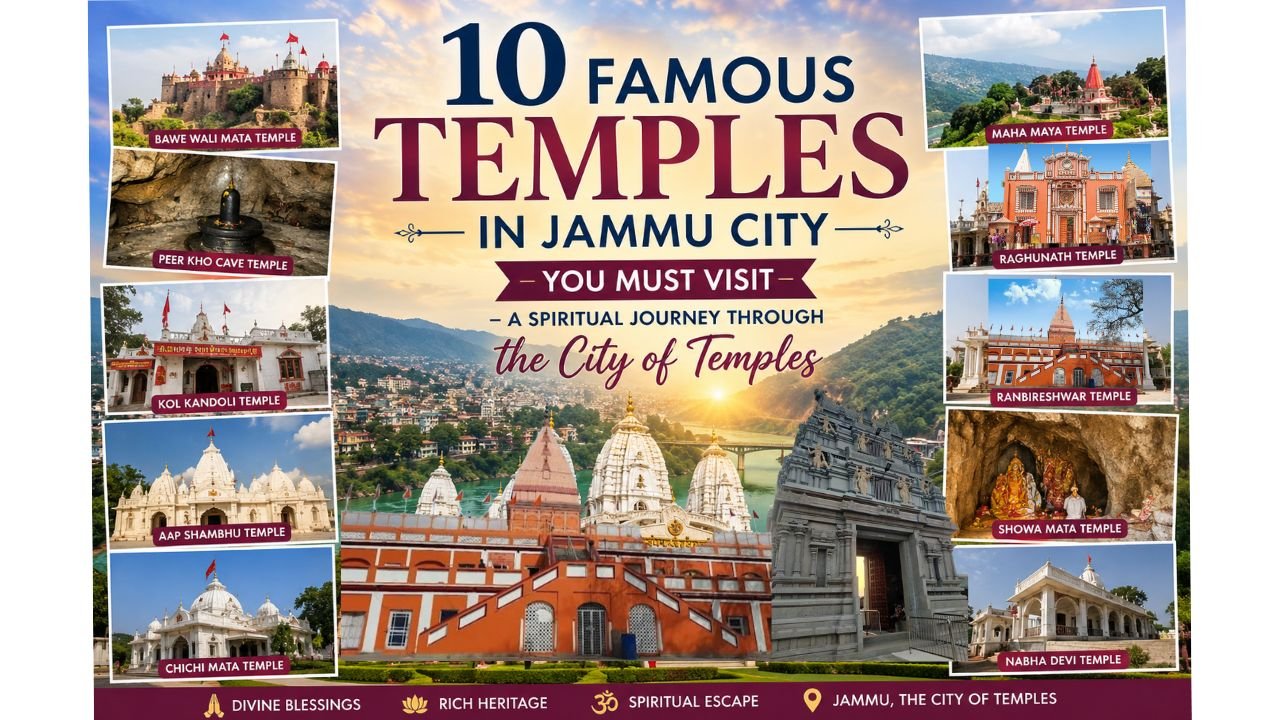
Jammu, the winter capital of Jammu & Kashmir, is popularly known as the City of Temples. Situated on the banks of the Tawi River and surrounded by the Shivalik Hills, the city and its surrounding areas are home to ancient shrines, sacred caves, and centuries-old temples built during the reign of the Dogra kings.
Whether you’re visiting Jammu for tourism, on a spiritual retreat, or passing through on your way to the Vaishno Devi Yatra, these temples offer a mix of faith, history, striking architecture, and beautiful views. This guide covers six must-visit temples right within Jammu city, plus four more just a short drive away — so whether you have one afternoon or a full weekend, you’ll know exactly where to go.
Here are the 10 Jammu famous temple in Jammu City and nearby areas that every traveler should visit.
1. Bawe Wali Mata Temple (Bahu Fort Temple)
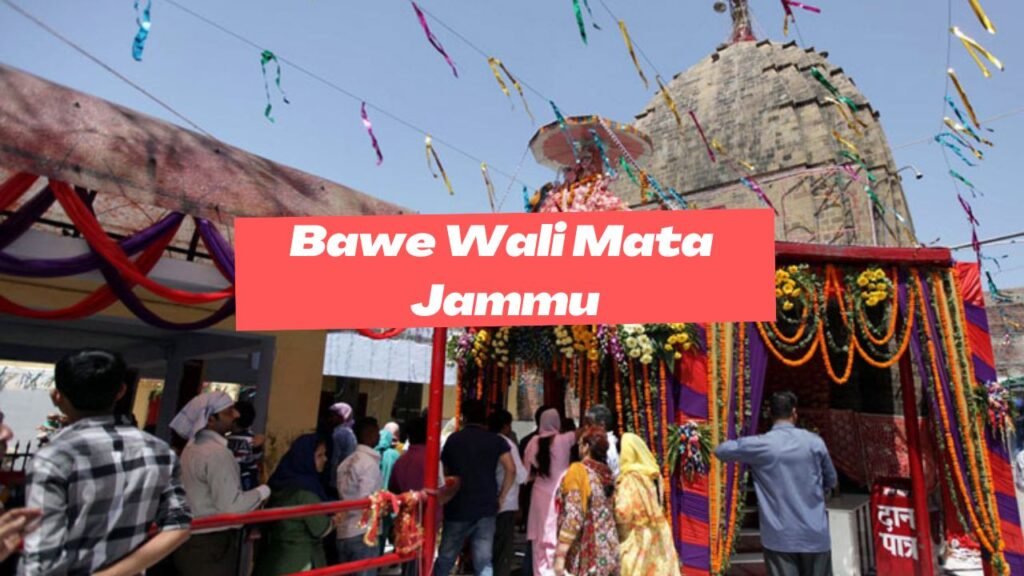
One of the oldest and most revered temples in Jammu, Bawe Wali Mata Temple is believed to be over 3,000 years old. Located inside the historic Bahu Fort on the banks of the Tawi River, the temple is dedicated to Goddess Kali. The fort complex itself was built by Raja Bahulochan and later renovated by the Dogra rulers, giving the site both religious and architectural significance.
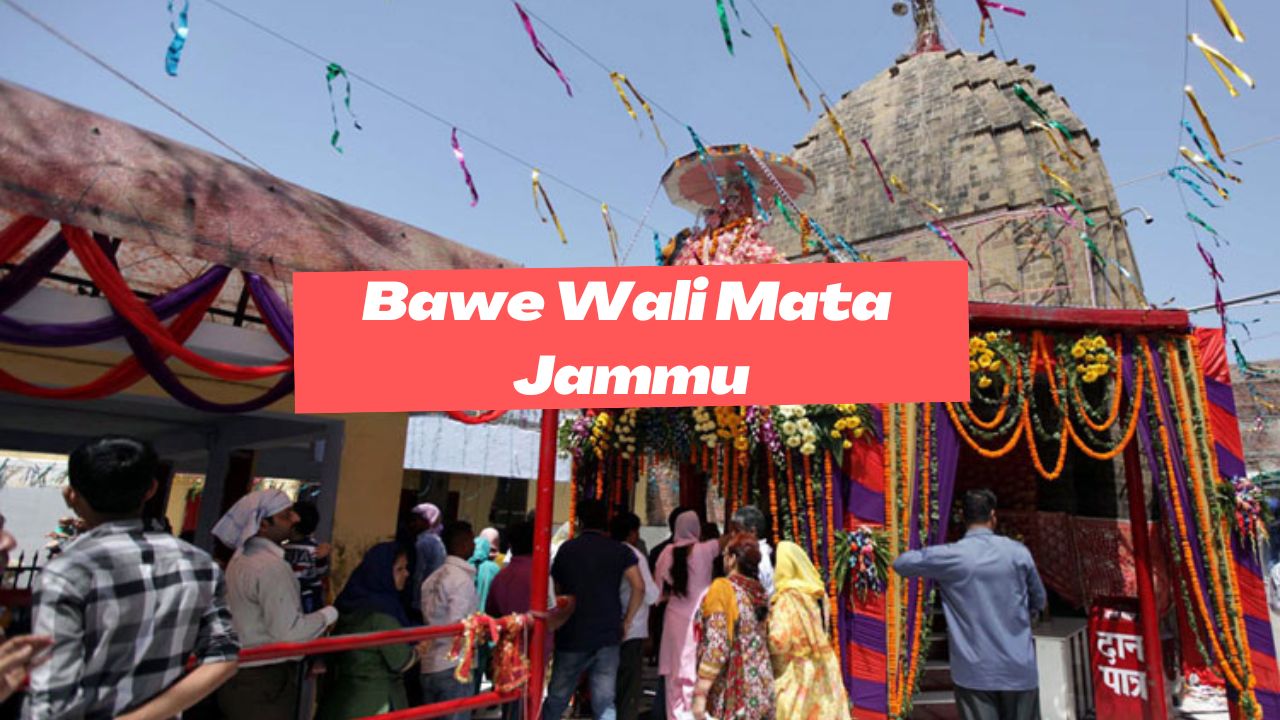
The temple attracts thousands of devotees every week, especially on Tuesdays and Sundays, which are considered auspicious for worship here. Beyond the temple itself, the location offers some of the best panoramic views in the city — the Tawi River below, terraced Mughal-style gardens, a small waterfall, and the surrounding hills.
Highlights:
- Dedicated to Goddess Kali, over 3,000 years old
- Located inside Bahu Fort
- Panoramic views of Jammu City, Tawi River, and terraced gardens
- Major Navratri celebrations
Location: Gorkha Nagar, Jammu | Timings: 5:00 AM – 10:00 PM | Best Time to Visit: October–March, or during Navratri | Nearest Railway Station: Jammu Tawi | Nearest Airport: Jammu Airport (Satwari).
2. Peer Kho Cave Temple

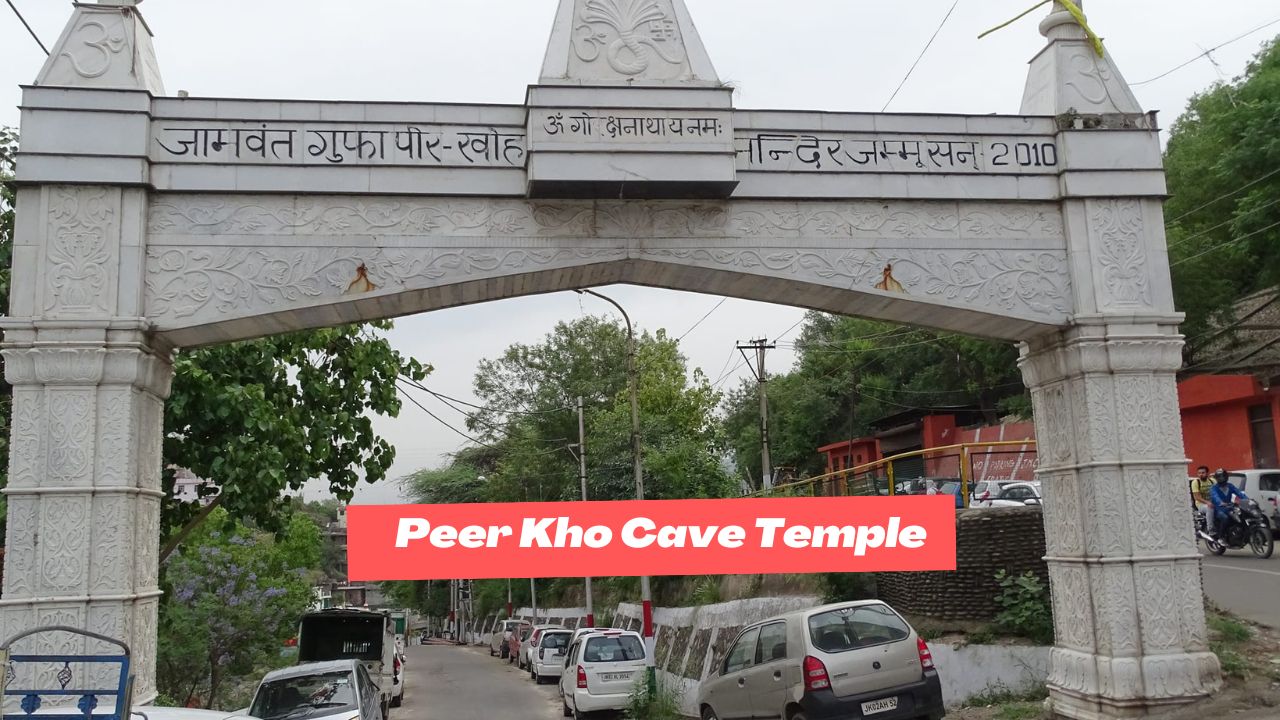
Perched above the Tawi River, Peer Kho Cave Temple is one of Jammu’s most ancient Shiva shrines. The temple is built around a natural cave system housing a self-manifested (Swayambhu) black Shiva Lingam inside a 12-foot-high cave chamber. According to legend, the cave was once used by Jamwant, the bear king from the Ramayana, as a place of meditation — one of the few sites in the region with a direct mythological link to the epic.
The cool, quiet interior of the cave stands in contrast to the busy city outside, making it a popular stop for both pilgrims and those simply looking for a peaceful half-hour away from the crowds.
Highlights:
- Natural underground cave temple
- Swayambhu (self-manifested) Shiva Lingam
- Direct connection to Ramayana legends
- Peaceful, meditative atmosphere
Location: Circular Road, Jammu | Distance from Railway Station: ~5 km | Timings: 5:00 AM – 7:00 PM | Best Time to Visit: October–March | Nearest Airport: Jammu Airport (Satwari).
3. Kol Kandoli Temple

Located in Nagrota, around 13 km from Jammu city, Kol Kandoli Temple is traditionally considered the first stop on the Vaishno Devi pilgrimage route. Local legend ties it to the Pandavas, who are said to have built the temple during their exile, while another story tells of Goddess Vaishno Devi feeding villagers using a divine bowl, or “Kol” — the source of the temple’s name. The site also houses the sacred Ghandeshwari Mahadev shrine.
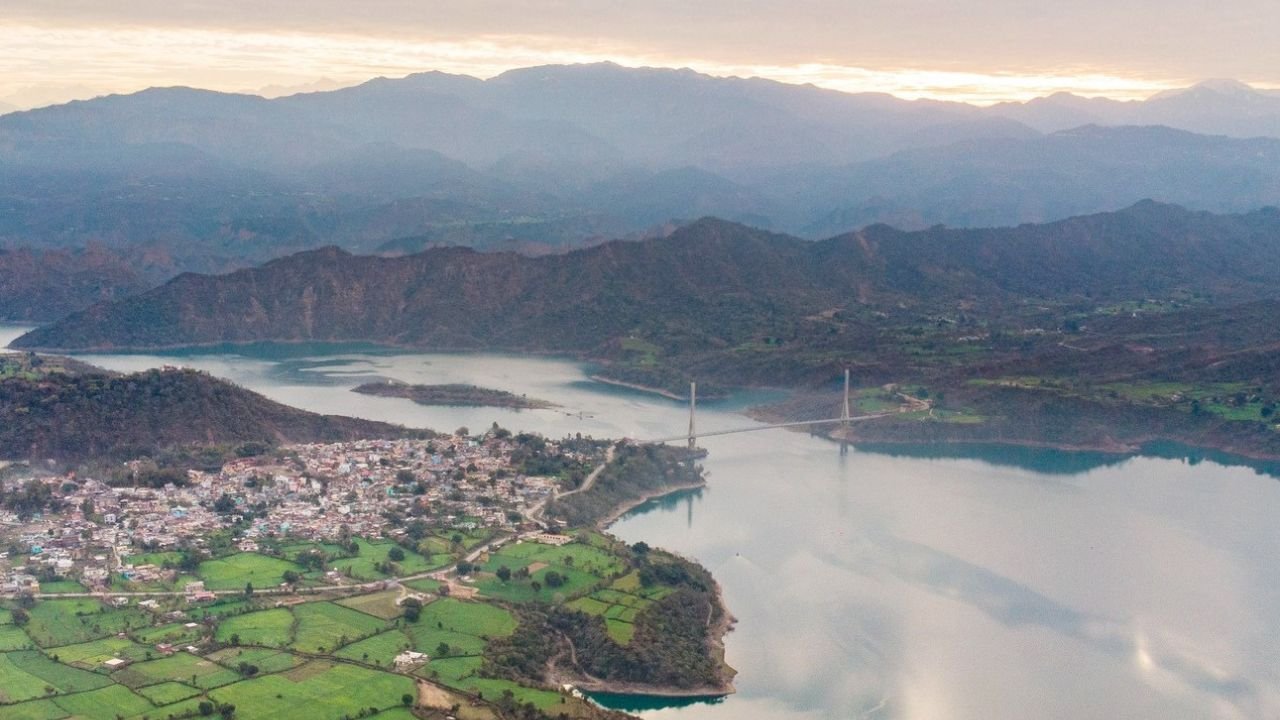
Highlights:
- Traditional first stop of the Vaishno Devi Yatra
- Strong Mahabharata-era legends
- Sacred Ghandeshwari Mahadev shrine
- Popular stop for pilgrims heading to Katra
Location: Nagrota, ~13 km from Jammu city | Best Time to Visit: October–March | How to Reach: ~25–30 minute drive by taxi or local bus from Jammu city
4. Tirupati Balaji Mandir, Sidhra, Jammu

One of the most prominent and recently developed religious landmarks in the region, the Tirupati Balaji Temple in Sidhra is managed directly by the Tirumala Tirupati Devasthanams (TTD) — the same trust that runs the original temple in Andhra Pradesh. The complex spans 62 acres of landscaped hills on the outskirts of Jammu city and was built as a faithful replica of the Tirumala Venkateswara Temple, letting devotees seek Lord Balaji’s blessings without traveling south.
The main sanctum houses a majestic idol of Lord Venkateswara crafted in traditional Tirumala style, with dedicated shrines for Goddess Padmavati and Goddess Andal alongside it. All rituals and ceremonies follow the same customs observed at the original Tirumala temple, making it a genuinely authentic experience rather than a simplified copy.
Highlights:
- Managed by Tirumala Tirupati Devasthanams (TTD)
- Spread across 62 acres of landscaped hills
- Faithful replica of the Tirumala Venkateswara Temple
- Dedicated shrines for Padmavati and Andal
- One of the largest temple complexes in Jammu
Location: Sidhra, Majeen Area, Jammu | Best Time to Visit: October–March | Nearest Railway Station: Jammu Tawi | Nearest Airport: Jammu Airport (Satwari)
5. Chichi Mata Temple
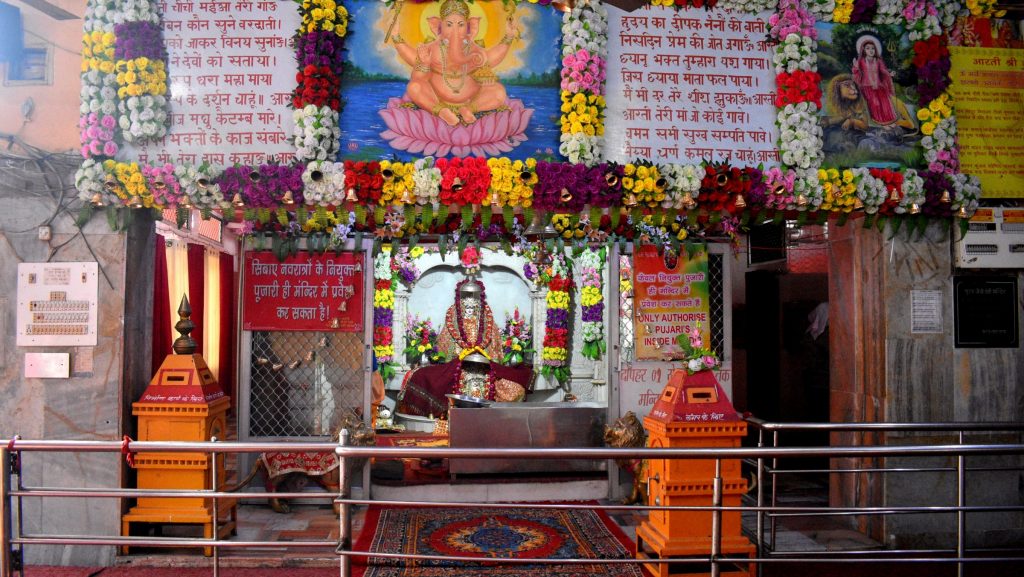
Located in Samba district, Chichi Mata Temple is regarded as the “Pehla Darshan” (first sighting) for devotees journeying toward Mata Vaishno Devi. According to legend, this is where the smallest finger of Goddess Sati fell, making it one of the significant Shakti worship sites associated with the Sati legend across the subcontinent.
According to legend, the smallest finger of Goddess Sati fell here, making it an important Shakti worship site.
Highlights:
- Regarded as “Pehla Darshan” before the Vaishno Devi Yatra
- Ancient Shakti Peeth linked to Goddess Sati
- Major Navratri celebrations
- Peaceful, less crowded surroundings
Location: Samba District | Best Time to Visit: October–March, or during Navratri | How to Reach: By taxi or private vehicle from Jammu city
6. Maha Maya Temple
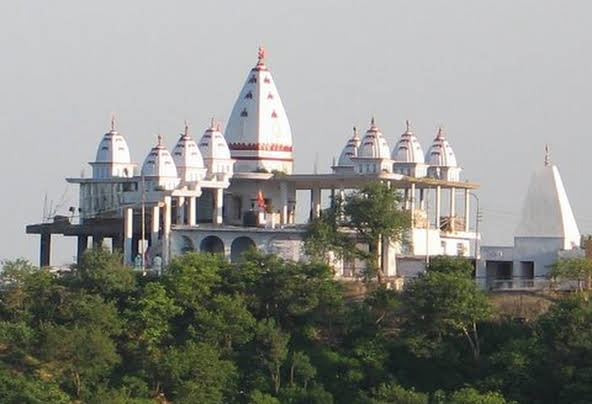
Situated on a ridge directly opposite Bahu Fort, Maha Maya Temple offers some of the most spectacular views of Jammu city and the surrounding forest cover — arguably better than the fort itself, and with a fraction of the crowd. Built during the reign of Maharaja Ranbir Singh, the temple houses a sacred Pindi representing the Goddess, kept in a simple, unadorned sanctum that reflects the site’s older, quieter character compared to Jammu’s larger temple complexes.
It’s an easy add-on to a Bahu Fort visit, and one of the better spots in the city for photography at sunset.

Highlights:
- Scenic hilltop location opposite Bahu Fort
- Stunning views of Jammu city and forests
- Peaceful, uncrowded atmosphere
- Built during Maharaja Ranbir Singh’s reign
Location: Bypass Road, Jammu | Best Time to Visit: October–March, evenings for sunset views | Nearest Railway Station: Jammu Tawi
7. Raghunath Temple

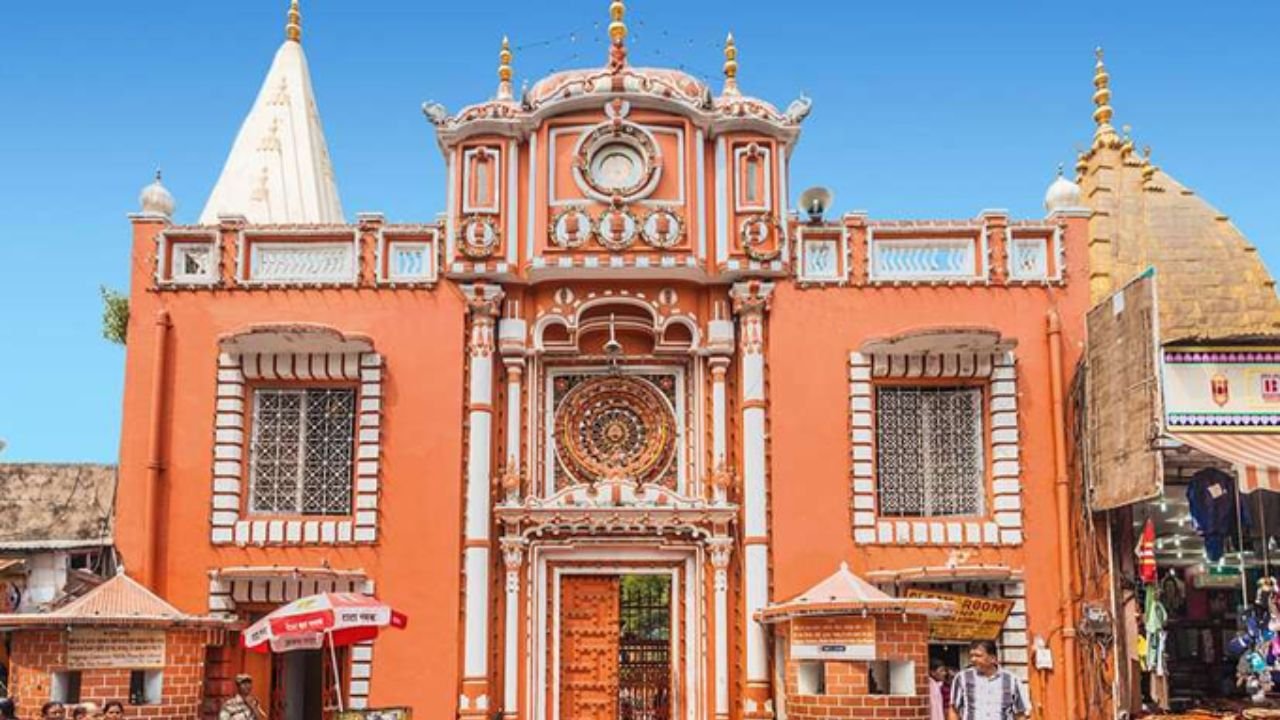
The Raghunath Temple is the most famous temple in Jammu and one of the largest temple complexes in North India. Construction began under Maharaja Gulab Singh and was completed by his son, Maharaja Ranbir Singh, in the mid-19th century. Dedicated to Lord Rama, Sita, and Lakshman, the complex actually contains seven interconnected shrines, the most important housing the idols of the central deities.
What sets Raghunath Temple apart is the sheer scale of detail inside: gold-plated interior walls, a huge collection of sacred Saligrams, and an on-site Sanskrit library holding rare manuscripts — making it as much a heritage and architectural site as a place of worship.
Highlights:
- Largest temple complex in North India
- Gold-plated interior walls
- Rare Sanskrit manuscript library
- Located in the heart of Jammu city
Location: Raghunath Bazaar, Jammu | Timings: 6:00 AM – 9:00 PM | Best Time to Visit: October–March | Nearest Railway Station: Jammu Tawi (~2 km)
8. Ranbireshwar Temple
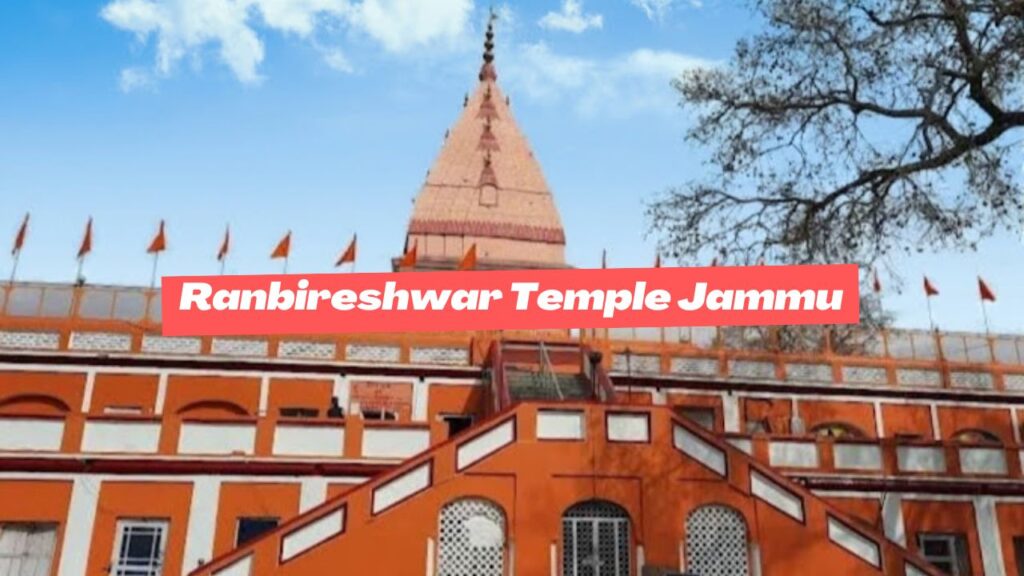
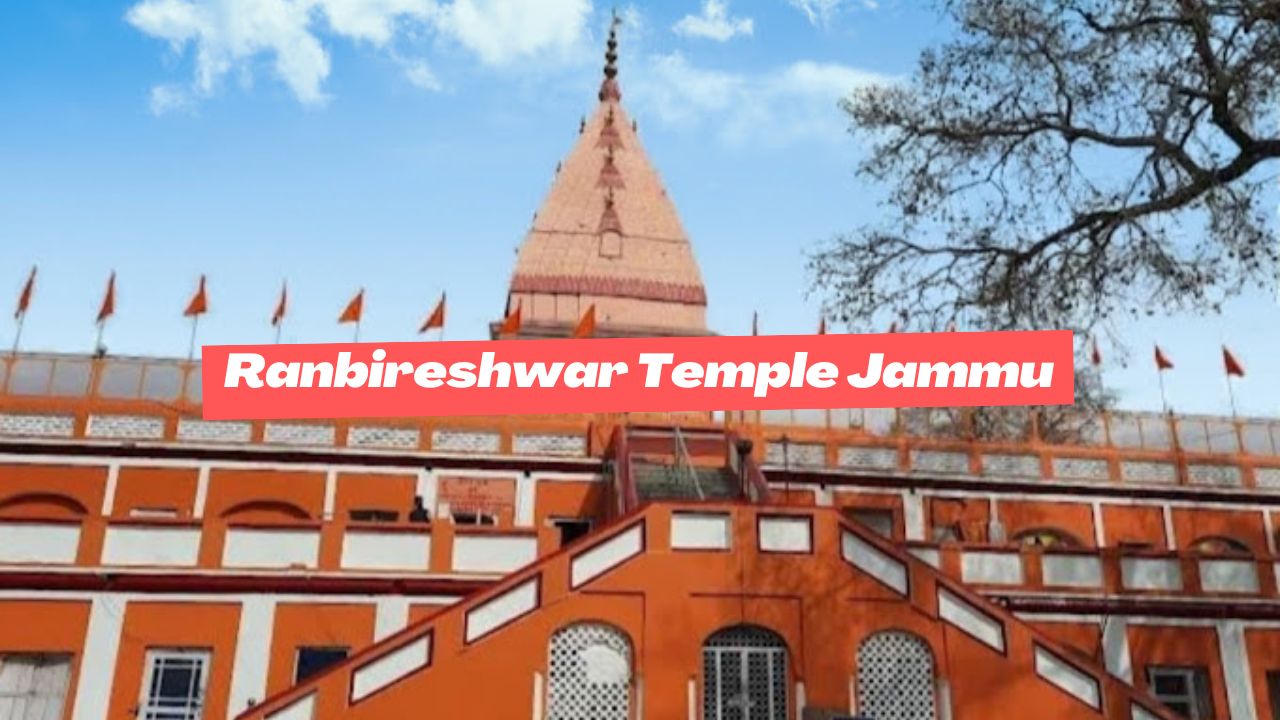
Named after its founder, Maharaja Ranbir Singh, Ranbireshwar Temple is one of the largest Shiva temples in North India. Its centerpiece is an 8-foot-high black stone Shiva Lingam — among the biggest in the country — surrounded by 12 crystal Shivlings and, remarkably, over 1.25 lakh miniature Shiva Lingams lining the temple’s galleries, brought from the Narmada river.
The scale of the lingam collection alone makes this a worthwhile stop even outside of festival season, though it’s at its most crowded and vibrant during Shivratri.
Highlights:
- Massive 8-foot black stone Shiva Lingam
- 12 crystal Shivlings
- Over 1.25 lakh miniature Shiva Lingams
- Major Shivratri celebrations
Location: Shalamar Road, Jammu | Timings: 5:00 AM – 8:00 PM | Best Time to Visit: Shivratri (Feb/March) or October–March generally
9. Showa Mata Temple
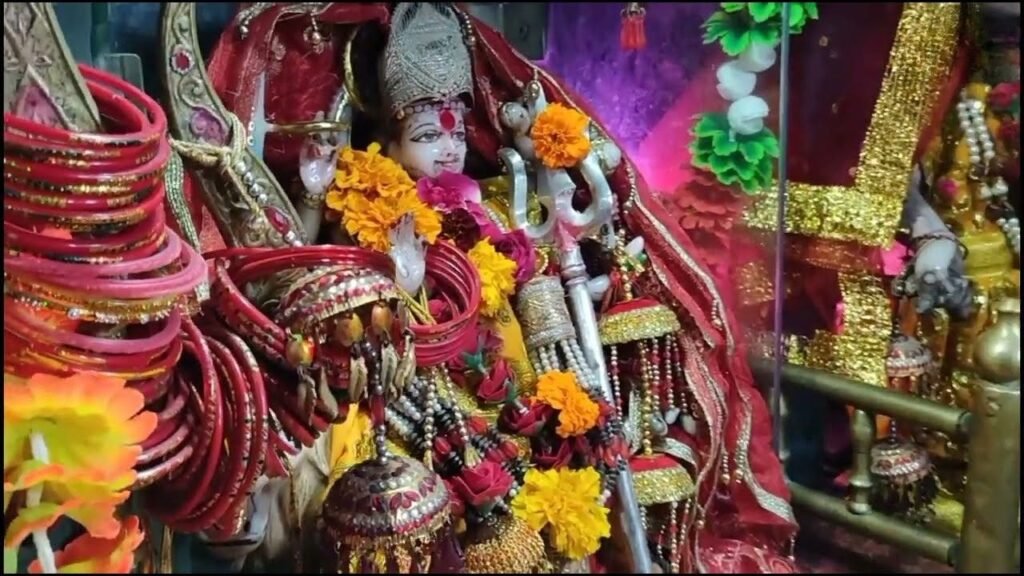
Hidden in the hills near Gharota, Showa Mata Mandir is one of the more offbeat entries on this list — a genuine escape from the city rather than a well-trodden tourist stop. The temple is built around a natural cave containing five sacred Pindis representing different forms of the Goddess: Mata Vaishno Devi, Lakshmi, Saraswati, Kali, and Shiva. The cave itself is roughly 12 meters long and accessed by lying down and crawling partway in, opening into a chamber where a natural Shivalinga stands, with mineral-rich water continuously trickling onto it from formations above. A further passage is said to connect to the Vaishno Devi cave itself, though it has long been sealed off due to low oxygen levels.
Highlights:
- Natural cave shrine with five sacred Pindis
- Believed to date back to the Treta Yuga
- Passage said to connect to the Vaishno Devi cave (sealed)
- Peaceful, off-the-beaten-path setting
Location: Near Gharota, ~25–30 km from Jammu | Best Time to Visit: October–March | How to Reach: ~45–60 minute drive from Jammu city
10. Nabha Devi Temple
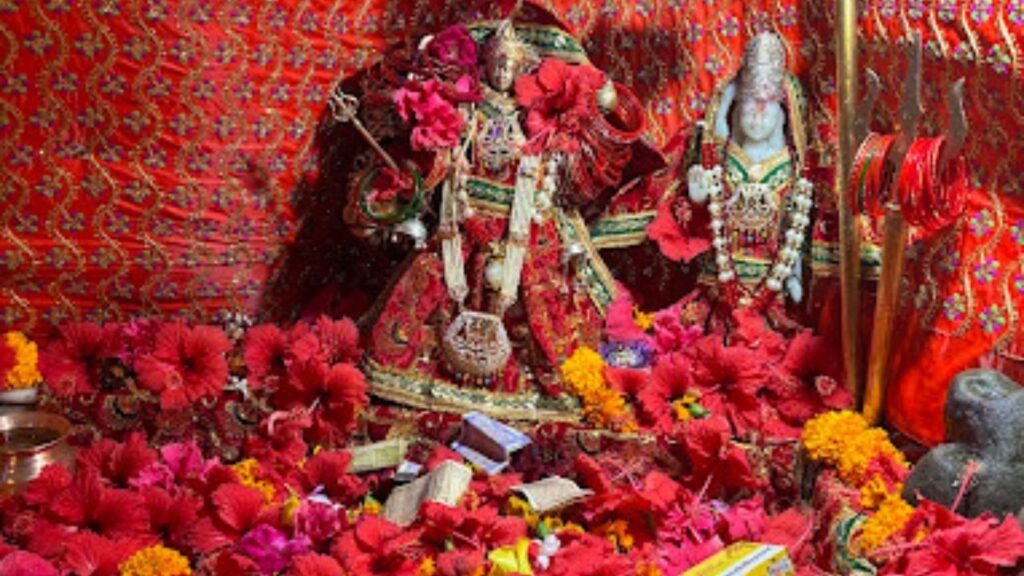
One of the 51 revered Shaktipeeths, Nabha Devi Temple sits in the quiet village of Kanyala, near Jindrah. Tradition holds that the navel (Nabhi) of Goddess Sati fell at this exact spot, giving the temple its name and its status as an important pilgrimage site for Shakti worship. It draws steady devotion year-round from those seeking blessings, despite being one of the more remote entries on this list.
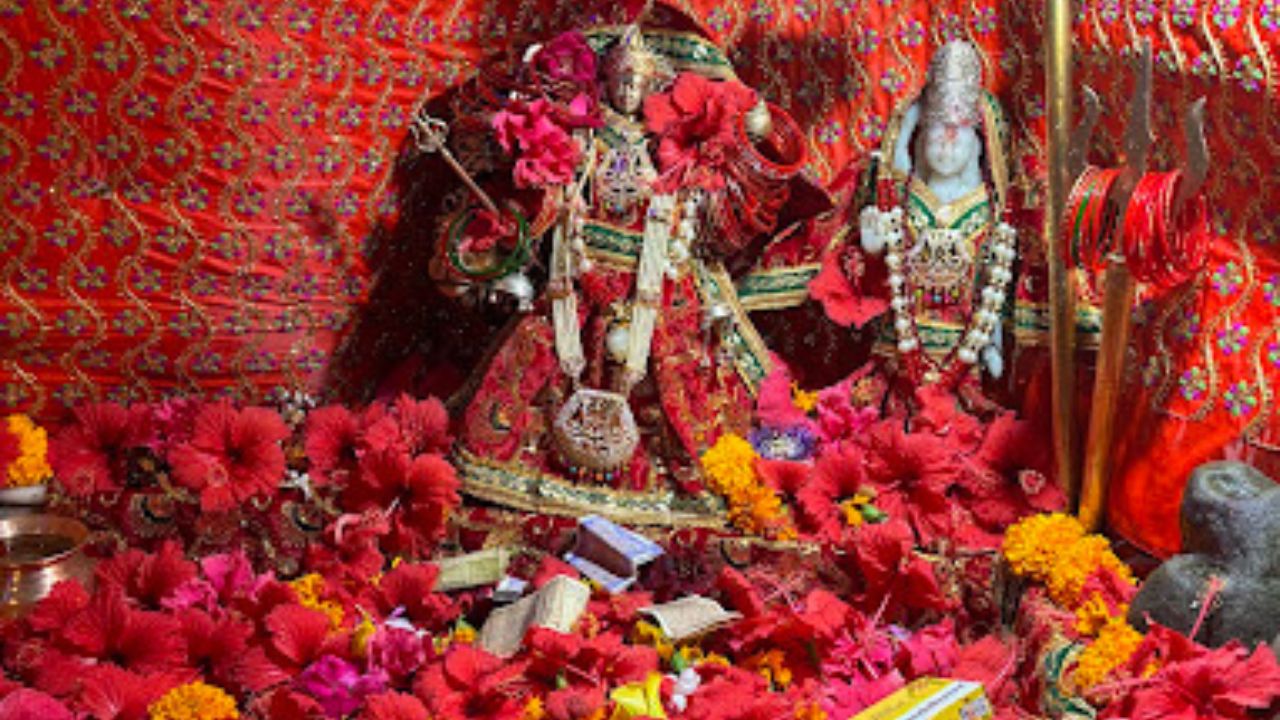
Thousands of devotees visit the temple seeking blessings and fulfillment of wishes.
Highlights:
- One of the 51 revered Shaktipeeths
- Ancient spiritual significance tied to the Sati legend
- Peaceful, rural setting
- Strong local devotion and tradition
Location: Kanyala Village, near Jindrah, ~45 km from Jammu | Best Time to Visit: October–March | How to Reach: Private vehicle recommended; roughly 60–75 minutes from Jammu city.
Which Temples Should You Visit First?
If you only have one day in Jammu, prioritize Raghunath Temple, Ranbireshwar Temple, and Bahu Fort’s Bawe Wali Mata Temple — all within the city and easily covered in a single morning by taxi or auto-rickshaw. If you have a second day or are heading toward Katra for the Vaishno Devi Yatra, add Kol Kandoli and Tirupati Balaji to your route, since both sit conveniently along the way.
For those with more time and an interest in offbeat, less-visited sites, Showa Mata and Nabha Devi reward the extra travel with a quieter, more contemplative experience away from the main pilgrim crowds.
Frequently Asked Questions
Which is the most famous temple in Jammu city?
Raghunath Temple is widely regarded as the most famous, both for its religious significance and its scale — it’s one of the largest temple complexes in North India.
How many days do you need to visit the temples of Jammu?
The six temples within Jammu city can comfortably be covered in a single day. If you want to include the four nearby temples as well, plan for two days.
Are these temples open to all visitors, regardless of religion?
Most temples in Jammu welcome visitors of all backgrounds who wish to observe respectfully. Some inner sanctums may have specific entry rules — check locally on arrival.
What is the best time of year to visit Jammu’s temples?
October to March offers the most comfortable weather. Navratri (usually September/October or March/April) is the most vibrant time to visit, though also the most crowded.
Is Jammu city worth visiting just for its temples?
Yes — beyond their religious significance, temples like Raghunath and Bahu Fort’s Bawe Wali Mata are major heritage and architectural sites in their own right, reflecting over a century of Dogra history