For thousands of rural families across Jammu and Kashmir, July 1 marks more than the launch of a government programme. It marks the beginning of a new chapter in rural employment, one that promises more workdays, stronger livelihoods and technology-driven transparency.
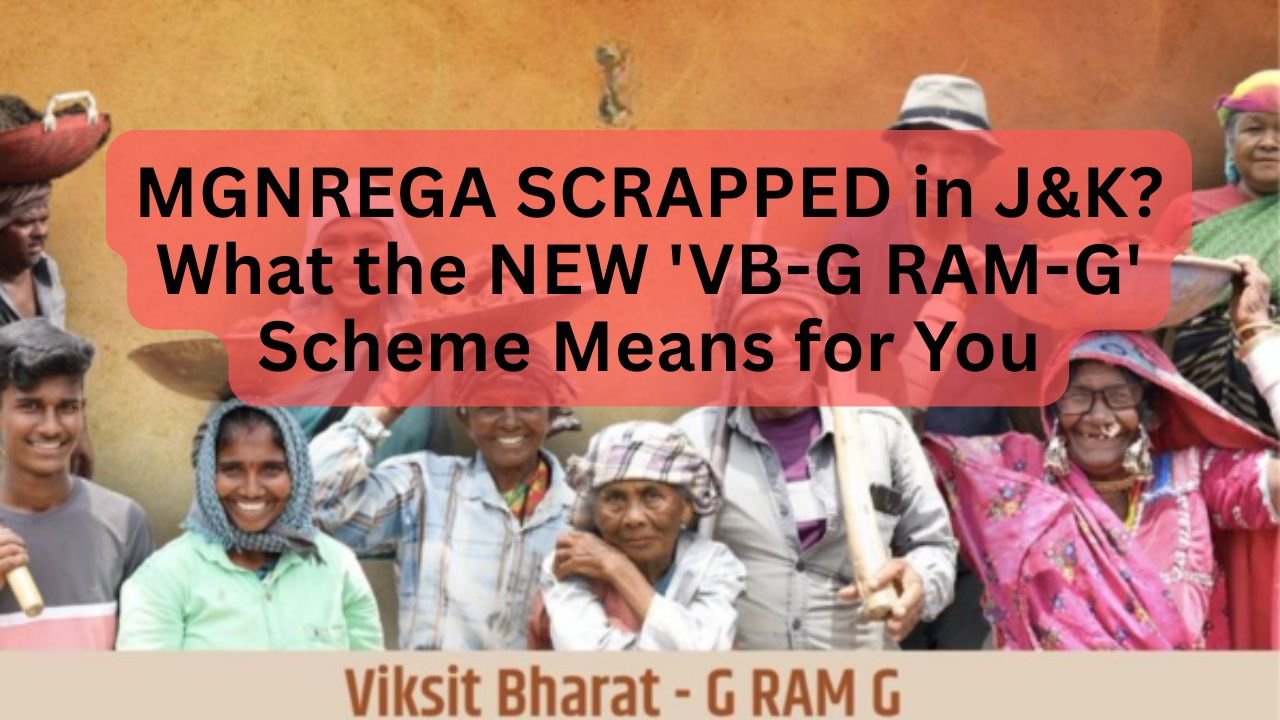
The Union Territory has officially replaced MGNREGA with the VB-G RAM-G Scheme, formally known as the Viksit Bharat-Guarantee for Rozgar and Ajeevika Mission (Gramin). Notified by Lieutenant Governor Manoj Sinha under the Viksit Bharat-Guarantee for Rozgar and Ajeevika Mission (Gramin) Act, 2025, the new initiative aims to strengthen rural livelihoods while supporting India’s vision of Viksit Bharat @2047.
A Bigger Employment Guarantee for Rural Families in Jammu & Kashmir
The most significant change is simple yet impactful.
While MGNREGA guaranteed 100 days of wage employment, the VB-G RAM-G Scheme increases that entitlement to 125 days of guaranteed wage employment every year for every eligible rural household willing to undertake unskilled manual work.
The scheme also strengthens worker protection. Employment must be provided within 15 days of demand. If work is not offered within that period, eligible applicants become entitled to unemployment allowance. Wages are to be paid weekly or within a fortnight, and compensation will be provided for payment delays.
For families dependent on seasonal income, these safeguards offer greater financial certainty.
Jammu & Kashmir Ready for the Rollout
The J&K Government has spent months preparing for the transition.
All 20 districts, 285 blocks and 4,291 Gram Panchayats have been onboarded with complete digital access. Planning has already begun in more than 94 percent of Gram Panchayats, while over 92 percent have submitted development plans.
More than 3,849 Gram Sabhas have approved local works, creating a pipeline of over 63,000 development projects that can generate employment as soon as labour demand arises.
This level of preparedness means the scheme begins with projects already identified instead of waiting for new proposals.
Supporting Farmers Alongside Workers
One notable feature of the new Jammu and Kashmir employment scheme is its recognition of agriculture’s seasonal demands.
Public works will remain suspended for 60 days during peak sowing and harvesting periods. This allows agricultural workers to participate in farming activities when labour is most needed, reducing conflicts between farm work and wage employment.
The approach attempts to strengthen both rural incomes and agricultural productivity rather than forcing workers to choose between the two.
Building Villages That Last
Employment is only one objective.
The VB-G RAM-G Scheme focuses on creating durable public assets that improve everyday life in villages. Development priorities include:
- Water security
- Core rural infrastructure
- Livelihood enhancement
- Climate resilience and disaster preparedness
Projects will be selected through Viksit Gram Panchayat Plans (VGPPs) using GIS mapping and PM Gati Shakti planning tools. The goal is to ensure that every project addresses local needs instead of following a one-size-fits-all approach.
Making Rural Employment More Inclusive
The scheme expands access for some of the country’s most vulnerable citizens.
Dedicated Gramin Rozgar Guarantee Cards will be issued to eligible beneficiaries, including single women, persons with disabilities, senior citizens, members of Particularly Vulnerable Tribal Groups (PVTGs), released bonded labourers and transgender persons.
Women also remain central to the programme, with at least one-third of beneficiaries required to be women. This continues the emphasis on women’s participation in rural employment while supporting household incomes across villages.
Technology Takes Centre Stage
Perhaps the biggest departure from the earlier system is the scale of digital governance.
The VB-G RAM-G Scheme introduces biometric and face-authenticated attendance, GPS-based work monitoring, geofencing, AI-powered analytics, real-time dashboards and bilingual electronic muster rolls.
Public disclosure of worksites and project information has also been made mandatory, strengthening transparency and making it easier for communities to monitor implementation.
Importantly, the use of contractors and labour-displacing machinery remains prohibited, ensuring that employment opportunities continue to reach rural workers rather than being replaced by machines.
Gram Panchayats Continue to Lead
Despite the technological upgrades, local governance remains at the heart of implementation.
Gram Panchayats will continue to register workers, issue employment guarantee cards, allocate work and execute approved projects. This decentralised model allows villages to retain control over local development priorities while benefiting from improved digital systems.
The programme will operate as a Centrally Sponsored Scheme with a 90:10 funding ratio between the Government of India and the Union Territory of Jammu and Kashmir.
Accountability Built Into the System
Strong monitoring mechanisms are another defining feature.
The framework includes mandatory social audits, independent evaluations, multi-level inspections and a time-bound grievance redressal system. These measures are intended to improve transparency, reduce implementation gaps and ensure that benefits reach eligible households efficiently.
A New Chapter for Rural Development in Jammu & Kashmir
Replacing MGNREGA with the VB-G RAM-G Scheme is more than an administrative change. It represents a broader effort to combine expanded employment guarantees with technology, local planning and sustainable infrastructure.
Whether the programme ultimately delivers on its promise will depend on effective implementation and continued community participation. Yet the foundations are ambitious: more guaranteed work, stronger protections for workers, better planning and thousands of projects already waiting to begin.
For rural Jammu and Kashmir, the success of the scheme will not be measured only by the number of days worked, but by whether it helps villages build stronger livelihoods, resilient infrastructure and lasting economic opportunities for the years ahead.