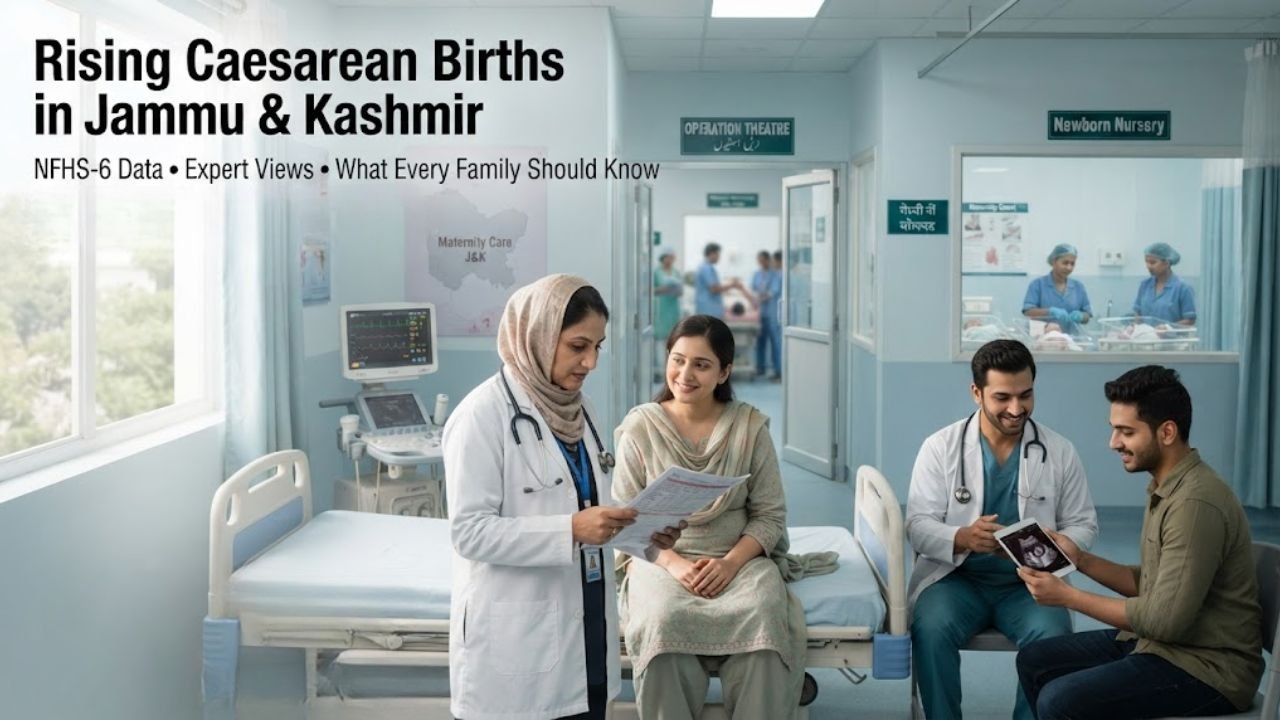
A new National Family Health Survey-6 (NFHS-6) (2023-24) has highlighted a major shift in childbirth practices across Jammu & Kashmir. More than half of all births in the Union Territory are now delivered through Caesarean section (C-section), while private hospitals have recorded an exceptionally high rate of surgical deliveries.
The findings have triggered discussions among doctors, expectant parents and public health experts about maternal healthcare, patient preferences and the increasing use of Caesarean deliveries.
C-Section Rate in Jammu & Kashmir Crosses 50%
According to NFHS-6 (2023-24), 51% of all births in Jammu & Kashmir were delivered through Caesarean section. This marks a significant increase from 41.7% recorded in NFHS-5 (2019-21).
The survey shows that Caesarean deliveries have increased in both government and private hospitals, although the rise is far steeper in the private sector.
Private Hospitals Report 90% C-Section Deliveries
The survey found that 90% of births in private hospitals were delivered through Caesarean section during 2023-24, compared with 82.1% in NFHS-5.
Government hospitals also recorded an increase. The C-section rate in public health facilities rose from 42.7% to 48.6% during the same period.
The report does not identify the reasons behind the increase. However, the large gap between private and government hospitals has raised questions about childbirth practices, medical decision-making and patient awareness.
Urban Areas Report Higher Caesarean Rates
The survey shows a clear difference between urban and rural areas.
- Urban Jammu & Kashmir: 68.9% of births by C-section.
- Rural Jammu & Kashmir: 47.1% of births by C-section.
The figures indicate that surgical deliveries are more common in urban healthcare facilities.
Institutional Deliveries Remain High
Despite the increase in Caesarean births, institutional deliveries continue to remain strong across Jammu & Kashmir.
According to NFHS-6, 93.6% of births in the Union Territory take place in healthcare institutions, indicating broad access to hospital-based maternal care.
Childbirth Costs Are Higher Than the National Average
The survey also compares childbirth expenses.
Across India, the average expenditure is:
- Government hospitals: ₹2,299
- Private hospitals: ₹37,630
In Jammu & Kashmir, the average expenditure is higher:
- Government hospitals: ₹3,867
- Private hospitals: ₹42,746
The data highlights the financial difference between public and private maternity care.
WHO Recommendation
The World Health Organization (WHO) states that Caesarean section rates at the population level should ideally remain between 10% and 15%. Higher rates are not automatically linked to better outcomes for mothers or newborns.
Jammu & Kashmir’s reported 51% overall C-section rate is well above this benchmark.
Doctors Say the Picture Is More Complex
The NFHS-6 report presents data but does not explain why Caesarean deliveries have increased. Medical professionals responding to the discussion on social media say multiple factors influence delivery decisions.
One doctor noted that government hospitals are generally better equipped to support prolonged labour because they have round-the-clock operation theatres, anaesthetists, paediatricians, blood banks and emergency teams. They argued that women with low-risk pregnancies who are suitable for vaginal delivery may have better opportunities for normal labour in such settings.
An obstetrics and gynaecology resident said many women and their families now request Caesarean delivery even when there is no medical indication. According to the doctor, government hospitals usually encourage vaginal birth when both mother and baby are healthy, while some patients choose private hospitals after requesting a planned C-section. The doctor added that counselling on the benefits and risks of each option remains an important part of maternity care.
Other healthcare professionals cautioned against assuming that every Caesarean section is unnecessary or financially motivated. They emphasised that C-sections are often life-saving procedures when complications threaten the mother or baby. They also called for informed consent, transparency and decisions based on medical necessity.
Why the Findings Matter for Jammu
The rising C-section rate in Jammu & Kashmir is likely to remain an important public health issue. The data highlights changing childbirth patterns, increasing healthcare costs and differences between public and private hospitals.
The report also underlines the need for continued public awareness, evidence-based medical practices and informed decision-making so that every expectant mother receives care suited to her medical condition.
As policymakers and healthcare providers review the findings, the focus will remain on ensuring safe deliveries, improving maternal health and maintaining access to quality maternity services across Jammu, Kashmir and other districts of the Union Territory.