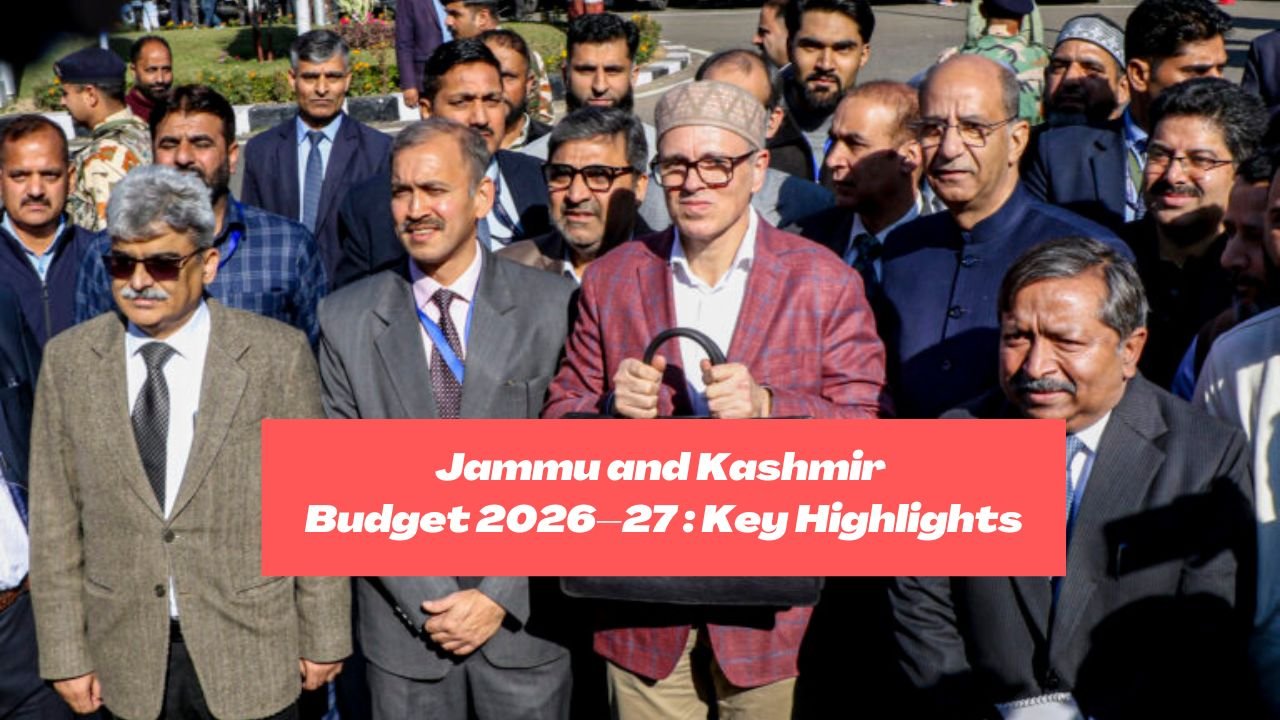
Jammu and Kashmir Chief Minister Omar Abdullah on Friday tabled a historic ₹1.27 lakh crore Budget for 2026–27 in the Legislative Assembly, outlining an ambitious roadmap to transform the Union Territory into a modern, progressive, and economically vibrant region.
Holding the finance portfolio himself, Abdullah said the Budget focuses on sustainable development, inclusive growth, and fiscal discipline, while placing people at the heart of governance.
“This Budget is not just a set of numbers—it is a fiscal compass guiding Jammu and Kashmir towards prosperity, social harmony, and long-term economic stability,” he told the House.
₹1.27 Lakh Crore Jammu & Kashmir Budget 2026–27: Key Financial Highlights
Presenting the financial framework, the Chief Minister estimated total gross receipts and expenditure at ₹1,27,767 crore, which includes ₹14,000 crore in ways and means advances and overdraft.
The net Budget size stands at ₹1,13,767 crore, excluding advances.
Major Budget Allocations
- Revenue expenditure: ₹80,640 crore
- Capital expenditure: ₹33,127 crore
- Expected revenue receipts: ₹90,018 crore
- Capital receipts: ₹23,749 crore
Jammu and Kashmir’s own tax and non-tax revenues are projected at ₹31,800 crore, while the Union Territory is expected to receive:
- ₹42,752 crore in central assistance
- ₹13,400 crore under Centrally Sponsored Schemes (CSS)
These figures underline the continued importance of Centre-state cooperation in J&K’s development journey.
GDP Growth and Fiscal Discipline Remain Central
Omar Abdullah highlighted steady economic momentum, announcing that:
- GDP for 2025–26 is projected at ₹2,88,422 crore, marking 9.5% growth
- GDP for 2026–27 is expected to reach ₹3,15,822 crore, maintaining a similar growth trajectory
On fiscal indicators:
- Tax-to-GDP ratio is projected at 6.6% for 2026–27
- Fiscal deficit for 2026–27 is estimated at 3.69%, slightly higher than 3.63% in 2025–26 (RE)
- The deficit had already dropped sharply from 5.5% in 2024–25 to 2.98% in 2025–26
The Chief Minister reaffirmed his government’s commitment to balancing growth with fiscal prudence.
“A Budget for the People”: Welfare Measures Take Centre Stage
Calling it a people-centric Budget, Abdullah announced a wide range of welfare initiatives aimed at easing household burdens and empowering vulnerable communities.
Major Social Welfare Announcements
- Full fee waivers for economically weaker students from Class 9 to college
- Six free LPG cylinders for eligible families
- Monthly financial support for orphan children
- Scholarships for tribal students
- Free government transport for persons with disabilities
“These steps will directly support families, strengthen social security, and ensure that no one is left behind,” he said.
Big Push for Agriculture, Horticulture, and Rural Development
To revive rural livelihoods and strengthen farm incomes, the Budget proposes:
- Crop insurance for apple, saffron, mango, and litchi
- Expansion of cold storage and warehousing facilities
- Promotion of micro and sprinkler irrigation
- Support for medicinal plant cultivation
- Livestock genetic improvement labs in every district
- Accelerated drive for ODF-Plus status in rural areas
These measures aim to modernise agriculture while boosting resilience against climate and market shocks.
Education and Youth Empowerment Get a Major Upgrade
Focusing on future-ready skills and learning, the government announced:
- JK e-Pathshala DTH channels for Classes 1–12
- Modernisation of anganwadi centres
- Indoor sports facilities in government schools
- Priority hiring of local youth in subsidised industries
Abdullah said the goal is to equip young people with opportunities at home, reducing migration and creating sustainable careers within Jammu and Kashmir.
Tackling Fiscal Stress and Strengthening Governance
Acknowledging financial constraints, the Chief Minister revealed that J&K’s own revenues currently meet only around 25% of budgetary needs.
By December 31, 2025:
- Tax collections: ₹10,265 crore
- Non-tax revenues: ₹4,964 crore
Nearly 60% of total expenditure goes towards salaries, pensions, and debt servicing. To address this, the government has:
- Enforced austerity measures for the third straight year
- Kept borrowings within approved limits
- Improved liquidity management
- Curbed non-priority spending
Power sector reforms—including expanding the consumer base and reducing losses—are also underway to ease financial pressure.
Centre’s Support and Infrastructure Push
Omar Abdullah acknowledged the Union government’s continued assistance, noting that J&K has been included under the Special Assistance to States for Capital Investment scheme.
Funds from this programme will support:
- Major infrastructure projects
- Hydroelectric development
- Disaster mitigation, especially in flood-prone areas
These investments are expected to strengthen long-term economic resilience.
Overcoming Challenges, Building a Business-Friendly J&K
Reflecting on recent setbacks—including geopolitical tensions, the Pahalgam terror attack, and devastating floods in parts of Jammu—the Chief Minister said sectors like tourism, handicrafts, horticulture, and agriculture suffered significant losses.
Despite this, the government remains focused on creating a business-friendly ecosystem, promoting innovation, and attracting fresh investment.
“The Budget was shaped through wide consultations with elected representatives, industry leaders, and stakeholders to ensure it truly reflects people’s aspirations,” Abdullah said.
Closing his address, Omar Abdullah urged lawmakers to work together for the region’s future.
“With humility and resolve, I present this Budget as a shared vision. Together, we will turn obstacles into stepping stones and aspirations into achievements,” he said.
The Jammu and Kashmir Budget 2026–27 stands as a bold declaration of intent—combining fiscal responsibility with social compassion—to steer the Union Territory toward jobs, growth, and lasting prosperity.