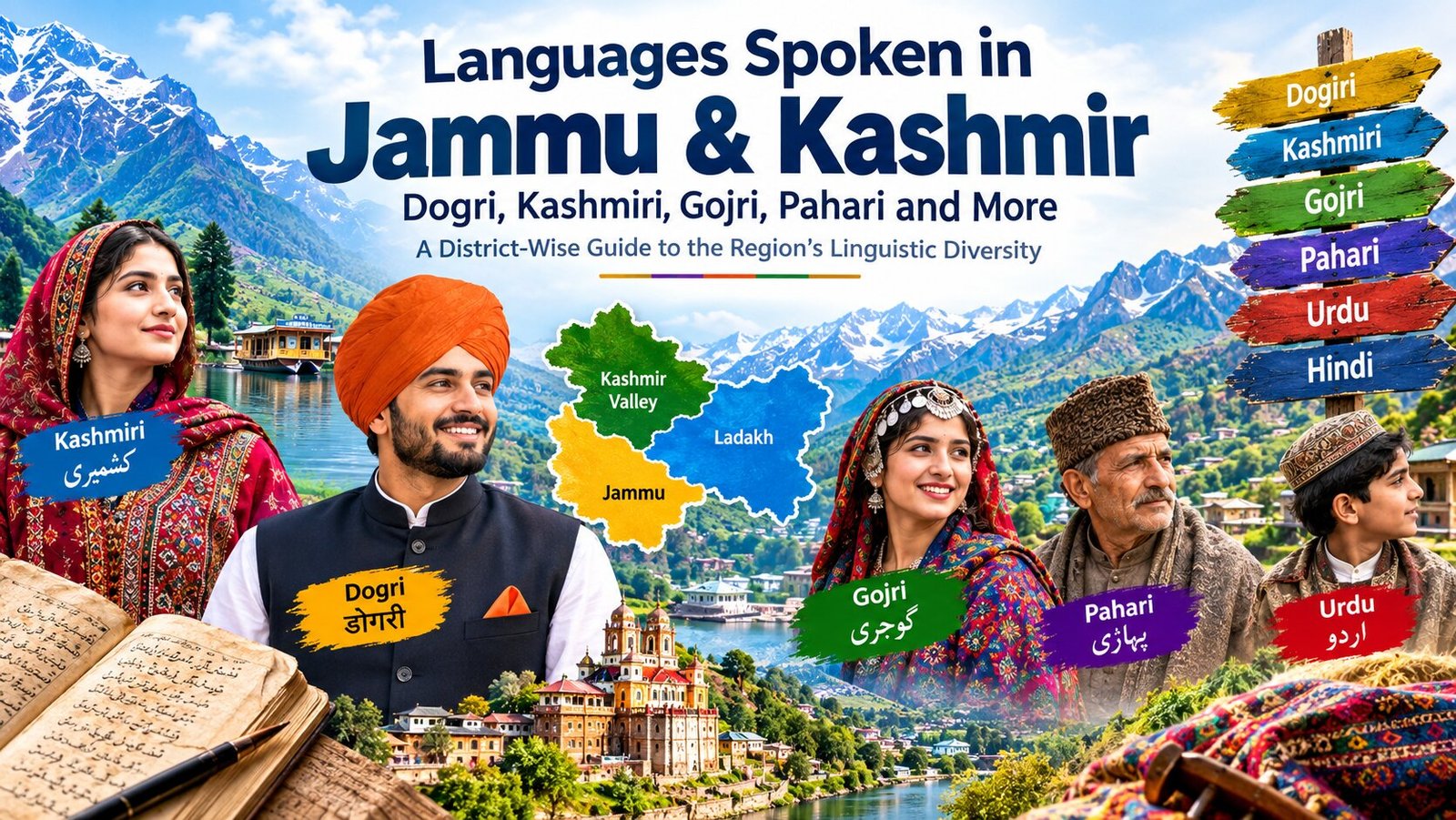
Jammu & Kashmir is one of India’s linguistically diverse regions. Languages change across the plains of Jammu, the Pir Panjal, the Chenab Valley and the Kashmir Valley, with several regional languages and speech varieties existing alongside Hindi, Urdu, Punjabi and English.
The linguistic pattern is closely connected with geography, migration, trade, community traditions and the historical interaction between neighbouring regions.
For Jammu, Dogri remains the principal regional language and an important part of Dogra cultural identity. Across the wider Union Territory, Kashmiri, Gojri, Pahari, Kishtwari, Bhaderwahi, Pogali, Sarazi and other regional varieties are also spoken.
The 2011 Census of India provides the principal official dataset for mother-tongue distribution in the former state of Jammu & Kashmir. The Census classifies mother tongues within broader language groupings, which is important when discussing regional languages and dialects.
Jammu & Kashmir’s Official Languages
The Jammu and Kashmir Official Languages Act, 2020, established Kashmiri, Dogri, Hindi, Urdu and English as the official languages of the Union Territory for official purposes. The Act was enacted on 26 September 2020 and came into force on 29 September 2020.
This official-language framework is different from the wider linguistic landscape of Jammu & Kashmir. Languages such as Gojri, Pahari, Punjabi, Bhaderwahi, Kishtwari and Pogali continue to be spoken in different communities and geographical areas.
The government has also maintained institutional mechanisms for the development of regional languages. Official records of the J&K cultural administration, for example, include editorial and cultural positions associated with Dogri, Kashmiri, Urdu, Gojri, Pahari and Punjabi.
What Does the 2011 Census Tell Us?
According to figures based on the 2011 Census, Kashmiri was the largest reported mother tongue in the former state, followed by Dogri. Published summaries of the Census data have reported Kashmiri at about 53.26% and Dogri at about 20.64% of the population. Gojri and Pahari were also significant language groups.
These percentages should be understood as 2011 Census mother-tongue figures, not as a current 2026 language survey. The official Census C-16 database provides mother-tongue data down to state, district and sub-district levels.
The Census also records many regional speech varieties under larger language categories. For example, Kishtwari and Siraji appear under the Kashmiri grouping in the Census classification, while Bhadrawahi, Gojri and Pahari appear within the relevant broader classifications.
This means that the number of languages or dialects people encounter on the ground can be considerably greater than the list of officially recognised languages.
Languages Across Jammu Division
Dogri
Main area: Jammu, Kathua, Samba, Udhampur and parts of Reasi and adjoining hill areas.
Dogri is the principal regional language of the Jammu plains and is strongly associated with Dogra cultural identity. It is an Indo-Aryan language and is included in the Eighth Schedule of the Constitution of India.
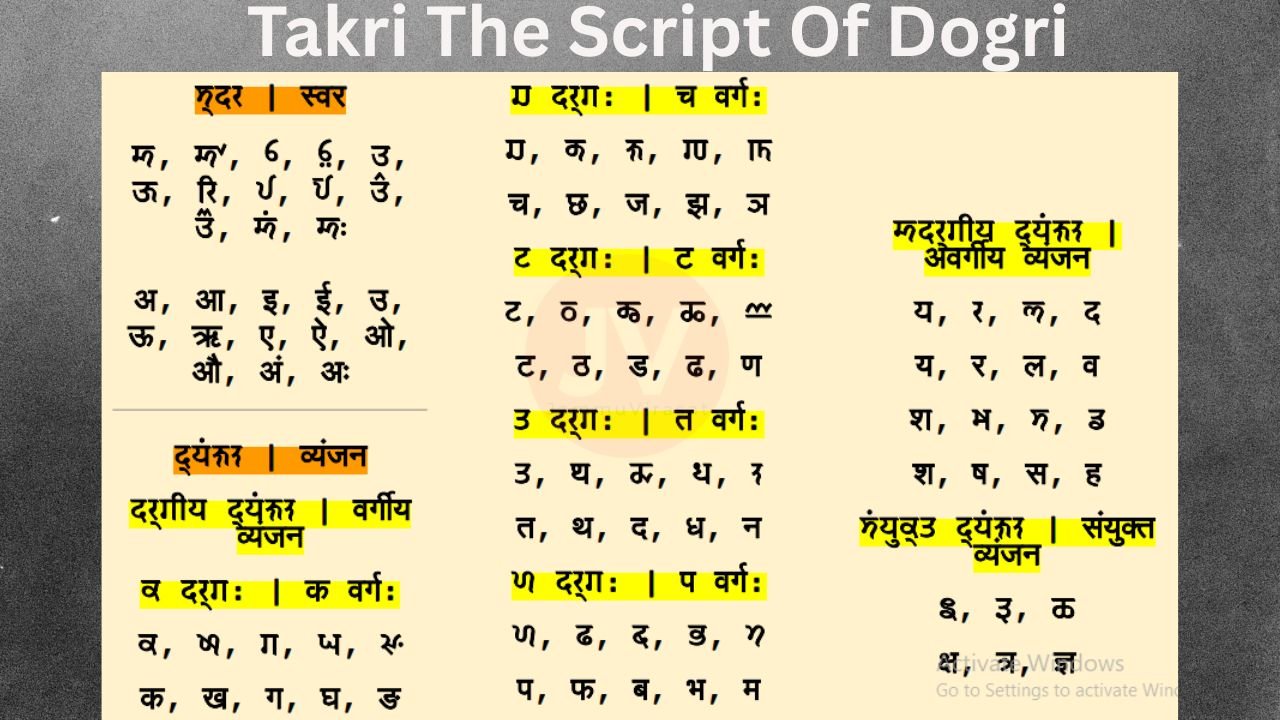
Dogri has a substantial literary tradition covering poetry, short stories, novels, drama, folk literature and oral traditions. The language is also associated historically with the Takri/Dogra Takri writing tradition. Government material on Dogri language and literature recognises Dogra Akkhar, Devanagari and Persian-related script traditions in different historical and administrative contexts.
Dogri is widely heard in Jammu city and across large parts of the Jammu plains. Its vocabulary and pronunciation also change as one moves towards the hills and areas bordering Punjabi- and Pahari-speaking communities.
The language continues to have a visible presence in Jammu’s public and cultural life. In August 2026, the Jammu Municipal Corporation announced the installation of Dogri-language signboards at prominent intersections and public locations in Jammu city.
Punjabi
Main area: Jammu city, border areas and communities with historical and social links with Punjab.
Punjabi is spoken in parts of Jammu, particularly among communities with historical connections with Punjab. It is also used in trade, family communication and cultural activities.
The presence of Punjabi is especially noticeable in areas where communities have moved between Jammu, Punjab and neighbouring regions over generations.
Punjabi is not one of the five official languages of the Union Territory under the 2020 Act, but it remains an important regional language with a longstanding presence in Jammu & Kashmir.
Hindi
Main area: Urban centres, Jammu city, educational institutions and areas with high inter-regional mobility.
Hindi is widely understood across Jammu & Kashmir and is commonly used in education, administration, business, media and communication between speakers of different mother tongues.
Its role has increased through education, migration, tourism, government services and mass media. The 2020 Official Languages Act included Hindi among the official languages of the Union Territory.
Urdu
Main area: Across Jammu & Kashmir.
Urdu has a long administrative and literary history in Jammu & Kashmir. It was an official language before the 2020 legislation and continues to be one of the five official languages under the Jammu and Kashmir Official Languages Act, 2020.
Urdu has also played an important role in literature, education, administration and public communication across both Jammu and Kashmir.
Gojri
Main area: Pir Panjal, Jammu hills, Rajouri, Poonch and scattered communities across the Union Territory.
Gojri is closely associated with Gujjar and Bakerwal communities, although language and community identity do not always correspond directly. Not every member of a Gujjar or Bakerwal community necessarily speaks Gojri as their first language.
Gojri belongs to the western Indo-Aryan linguistic group and has developed through long interaction with neighbouring languages such as Pahari, Hindko and Dogri.
It is particularly significant across the Pir Panjal region and is also spoken in scattered pockets of the Kashmir Valley.
The 2011 Census lists Gojri/Gujjari/Gujar within its mother-tongue classification.
Pahari
Main area: Rajouri, Poonch, parts of the Pir Panjal, Chenab Valley and scattered areas elsewhere.
“Pahari” is a broad term covering several related regional speech varieties rather than a single uniform language spoken identically throughout Jammu & Kashmir.
Different communities use local names for their speech varieties. These include forms associated with Poonch, Rajouri, Bhaderwah, Padder, Karnah and other mountainous areas.
Pahari varieties have developed through contact with neighbouring Dogri, Punjabi, Kashmiri, Gojri and other languages. Their vocabulary and pronunciation can therefore vary considerably from one valley or district to another.
Pahari is particularly important in the Pir Panjal region. It is also spoken in pockets of the Kashmir Valley, including areas such as Karnah and Uri, and in parts of the Chenab Valley.
Bhaderwahi
Main area: Bhaderwah and surrounding parts of Doda district.
Bhaderwahi is a regional Western Pahari language associated with the Bhaderwah area. It has its own vocabulary and pronunciation and is part of the complex linguistic pattern of the Chenab Valley.
The language reflects the area’s geographical position between Jammu, Kashmir and the western Himalayan linguistic zone.
Kishtwari
Main area: Kishtwar and surrounding areas.
Kishtwari is traditionally spoken in the Kishtwar region. The language has strong links with Kashmiri while also showing influence from neighbouring Western Pahari varieties.
The Jammu & Kashmir Tourism Department describes Kishtwar as a multilingual area where people speak Kashmiri, Urdu, Kishtwari, Hindi, Paddri, Pahari and Gojri, among other languages.
The Census classification places Kishtwari under the Kashmiri language grouping, illustrating why Census figures should not automatically be treated as a simple count of every locally recognised language.
Pogali
Main area: Pogal-Paristan and parts of Ramban district.
Pogali is associated with the Pogal-Paristan and Banihal areas of Ramban.
The language reflects prolonged interaction between neighbouring linguistic communities. The Jammu & Kashmir Tourism Department identifies Pogali, Kashmiri and Gojri among the main languages of the Ramban area.
Pogali is an example of how geographical isolation and contact between communities have produced distinctive regional speech forms within the Chenab Valley.
Sarazi or Siraji
Main area: Saraz region of Doda district.
Sarazi, also written as Siraji, is spoken in parts of Doda district. It is associated particularly with the Saraz region.
Like several other languages of the Chenab Valley, Sarazi exists within a multilingual environment in which speakers may also use Kashmiri, Dogri, Urdu, Hindi or other regional languages.
Padari or Padderi
Main area: Paddar Valley, Kishtwar district.
Padari, or Padderi, is associated with the Paddar Valley of Kishtwar.
The difficult mountainous terrain and historical isolation of the valley have contributed to the development and preservation of distinctive local speech patterns.
The 2011 Census records Padari within its broader mother-tongue classification.
Kashmiri
Main area: Kashmir Valley and parts of the Chenab Valley and adjoining areas.
Kashmiri, commonly called Koshur by its speakers, is the dominant mother tongue of the Kashmir Valley and the largest reported mother-tongue group in the 2011 Census for the former state.
Published analyses of the 2011 Census place Kashmiri at approximately 53.26% of the population of the former state.
Kashmiri has a substantial literary tradition and is used in poetry, songs, folklore, theatre and everyday communication.
Its geographical distribution is not confined entirely to the Valley. Kashmiri-speaking communities are also present in parts of the Chenab Valley and other areas.
Urdu
Urdu occupies a distinctive position in Jammu & Kashmir because of its historical role in administration and education.
The Jammu and Kashmir Official Languages Act, 2020, retained Urdu alongside English and added Kashmiri, Dogri and Hindi to the official-language framework.
Urdu is therefore important both as a language with native speakers and as a language historically used across communities for education, administration and written communication.
The Chenab Valley: Jammu & Kashmir’s Linguistic Meeting Point
The Chenab Valley provides one of the clearest examples of Jammu & Kashmir’s linguistic diversity.
Doda, Kishtwar and Ramban contain areas where Kashmiri, Dogri, Bhaderwahi, Sarazi, Kishtwari, Pogali, Gojri, Pahari and Urdu exist within relatively close geographical proximity.
The mountainous terrain has historically produced separate valleys and settlements, while trade, migration and contact between communities have encouraged linguistic exchange.
Kishtwar is particularly diverse. Government tourism information lists Kashmiri, Kishtwari, Urdu, Hindi, Paddri, Pahari and Gojri among the languages spoken in the district.
Ramban also demonstrates this pattern. The Tourism Department identifies Pogali, Kashmiri and Gojri as major languages of the area.
District-Wise Language Pattern
The following table provides a practical overview based on the supplied material, supplemented by Census classification and government information. It should be read as a description of major languages and regional speech varieties, not as an exhaustive list of every mother tongue spoken in each district.
| District | Major languages and speech varieties |
|---|---|
| Jammu | Dogri, Hindi, Punjabi, Urdu, Gojri and Pahari |
| Kathua | Dogri, Punjabi, Hindi and Pahari varieties |
| Samba | Dogri, Punjabi, Hindi and Gojri |
| Udhampur | Dogri, Hindi, Punjabi, Urdu, Gojri and Pahari varieties |
| Reasi | Dogri, Hindi and Pahari varieties |
| Ramban | Pogali, Kashmiri, Gojri, Dogri, Sarazi and Pahari |
| Doda | Bhaderwahi, Sarazi, Kashmiri, Gojri, Dogri and Urdu |
| Kishtwar | Kishtwari, Kashmiri, Paddri, Gojri, Bhaderwahi, Dogri, Hindi and Urdu |
| Rajouri | Pahari, Gojri, Hindi, Kashmiri, Dogri and Urdu |
| Poonch | Pahari, Gojri, Hindi, Kashmiri, Dogri and Urdu |
| Srinagar | Kashmiri, Urdu and Hindi |
| Ganderbal | Kashmiri, Urdu, Hindi, Gojri and Pashto |
| Budgam | Kashmiri, Urdu, Gojri and Hindi |
| Anantnag | Kashmiri, Urdu and Hindi |
| Kulgam | Kashmiri, Urdu and Hindi |
| Pulwama | Kashmiri, Gojri, Punjabi, Urdu and Hindi |
| Shopian | Kashmiri, Urdu and Hindi |
| Baramulla | Kashmiri, Pahari, Gojri, Punjabi, Hindi and Urdu |
| Kupwara | Kashmiri, Pahari, Gojri, Hindi and Urdu |
| Bandipora | Kashmiri, Pahari, Gojri, Shina, Hindi and Urdu |
The Census C-16 database is the appropriate primary reference for detailed district-level mother-tongue data. It records language information at state, district and sub-district levels and includes numerous mother tongues within broader language classifications.
Why Do Languages Change From One District to Another?
Geography is one of the major reasons.
The Jammu plains have historically maintained strong linguistic links with Dogri and Punjabi-speaking areas. As the landscape rises towards the Pir Panjal, Pahari and Gojri varieties become increasingly prominent.
The Chenab Valley has another linguistic pattern. Deep valleys and mountain passes historically separated communities, allowing languages such as Bhaderwahi, Sarazi, Kishtwari and Pogali to develop distinctive characteristics.
The Kashmir Valley has Kashmiri as its principal regional language, alongside Urdu, Hindi and other languages.
Migration has added another layer. Jammu city, for example, is a major commercial and administrative centre where Dogri, Hindi, Punjabi, Urdu and English are commonly encountered.
One Region, Multiple Languages
People in Jammu & Kashmir often use more than one language in their daily lives.
A person may speak a regional mother tongue at home, Hindi or Urdu in formal situations and English in education or professional settings. In border and inter-district areas, Punjabi, Gojri, Pahari or another neighbouring language may also be used.
The Census separately measures bilingualism and trilingualism, confirming that language use in Jammu & Kashmir cannot be understood only by counting people’s first or mother tongue.
Languages and Cultural Heritage
Language carries local names, folk songs, oral histories, proverbs, traditional knowledge and stories from one generation to another.
Dogri is closely associated with Dogra cultural traditions in Jammu. Gojri remains important among many Gujjar and Bakerwal communities. Pahari varieties form an important part of the cultural landscape of the Pir Panjal, while Kashmiri remains central to the cultural life of the Valley.
The smaller regional languages of the Chenab Valley also preserve local histories and traditions that are closely connected with individual valleys and communities.
Jammu’s Linguistic Identity
Jammu city provides a useful example of how the region’s languages interact.
Dogri remains the principal regional language, while Hindi, Punjabi, Urdu and English are widely used in different social, educational, commercial and administrative settings.
Recent public initiatives have also increased the visibility of Dogri in Jammu city. The Jammu Municipal Corporation announced in August 2026 that it was installing Dogri signboards at prominent intersections and public locations.
Such measures place the language in everyday public spaces rather than limiting it to literary and cultural programmes.
A Living Linguistic Map
The linguistic map of Jammu & Kashmir cannot be divided into rigid boundaries.
Languages overlap. A district may contain several linguistic communities, and a single family may use more than one language. Regional speech varieties may also change gradually as one moves from one valley to another.
The 2011 Census provides the most important official statistical baseline, while local government and cultural sources provide additional information about particular districts and communities.
For Jammu, the most visible part of this linguistic landscape is Dogri. Beyond the city and plains, the language map becomes progressively more diverse, bringing together Pahari, Gojri, Punjabi, Kashmiri and the distinctive languages of the Chenab Valley.
Together, these languages form an important part of Jammu & Kashmir’s social and cultural history.