The history of industrial development in Jammu and Kashmir dates back more than a century. A remarkable document titled “Report on the Development of Commerce and Industry in the State (1922 A.D.)” sheds light on how the then Darbar envisioned progress and prosperity through economic reforms and industrialization.
The Birth of a Commerce and Industry Department Jammu & Kashmir
In 1922, the Jammu and Kashmir State took a major step toward modernization by establishing a dedicated Department of Commerce and Industry. This decision, outlined in the report, reflected then Maharaja Pratap Singh’s determination to promote trade, attract investment, and ensure the sustainable industrial development of the State.
The report emphasized that this initiative aligned with global industrial trends of the time, aiming to secure the State’s economic future. The Darbar’s foresight in institutionalizing commerce and industry showed a commitment to long-term prosperity rather than short-term trade gains.
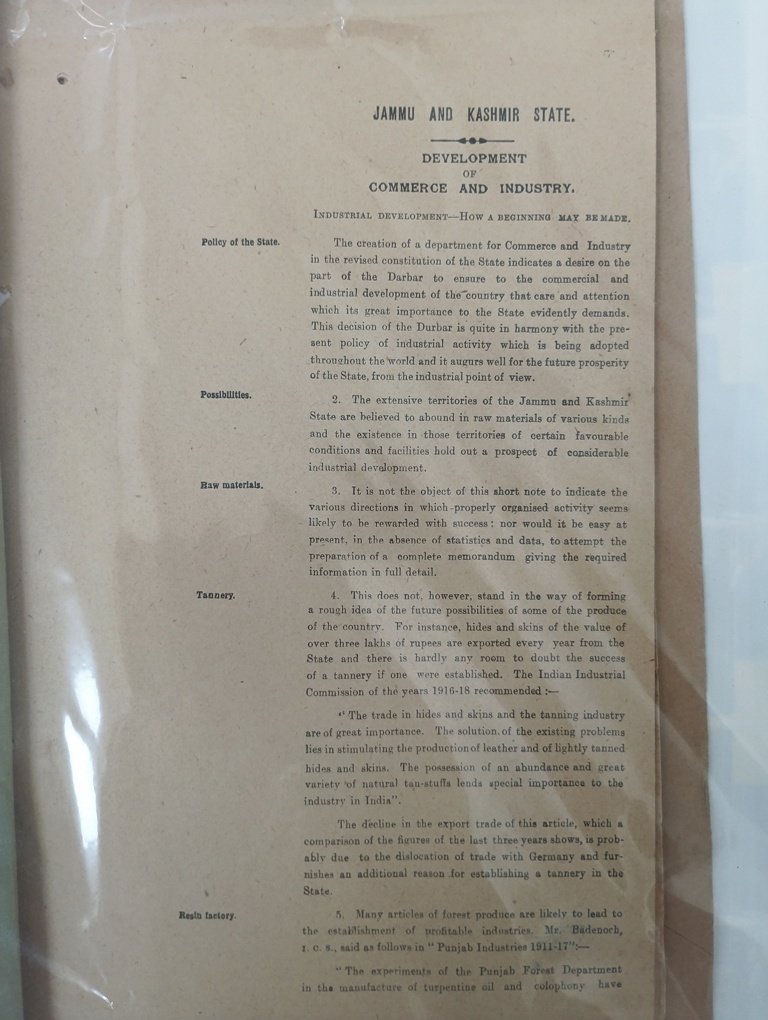
The 1922 report identified the vast industrial potential of Jammu and Kashmir. The State was recognized for its rich natural resources, including forests, minerals, and agricultural produce. It was believed that the region’s favorable climate and raw material availability could support a variety of industries — from forestry-based production to manufacturing.
The document highlighted that while comprehensive data was limited, there was no shortage of possibilities. It called for organized exploration of the State’s resources and the creation of detailed industrial reports — something akin to today’s industrial surveys and feasibility studies.

The Leather and Tannery Opportunity
One of the most notable recommendations in the report was the establishment of a tannery industry in Jammu and Kashmir. At the time, hides and skins worth over three lakhs of rupees were being exported annually. The Indian Industrial Commission (1916–18) had already underlined the importance of developing the leather industry in India, and Jammu and Kashmir was ideally positioned for it.
The report stated:
“The trade in hides and skins and the tanning industry are of great importance. The solution of the existing problem lies in stimulating the production of leather and lightly tanned hides and skins. The possession of an abundance and great variety of natural tan-stuffs lends special importance to the industry in India.”
The presence of natural tan-stuffs (materials used for tanning leather) offered the State a competitive advantage. Establishing a tannery locally would not only add value to raw materials but also reduce export dependency — a vision that reflected early industrial policy thinking.
Forest Products and Future Industries
Beyond tanning, the report noted opportunities in forest-based industries. Referring to experiments in Punjab, it suggested that the manufacture of turpentine oil and colophony could be replicated in Jammu and Kashmir. These products, derived from pine resin, had industrial applications in paints, varnishes, and pharmaceuticals — indicating the State’s early inclination toward sustainable resource-based industries.
This 1922 report remains a testament to Jammu and Kashmir’s progressive economic vision during the early 20th century. The establishment of a Commerce and Industry Department laid the groundwork for structured economic planning — a model that many Indian states adopted post-independence.
While the industrial landscape of Jammu and Kashmir has evolved significantly since then, revisiting this document reminds us that the foundation for economic self-reliance, resource utilization, and industrial innovation was laid more than a hundred years ago.