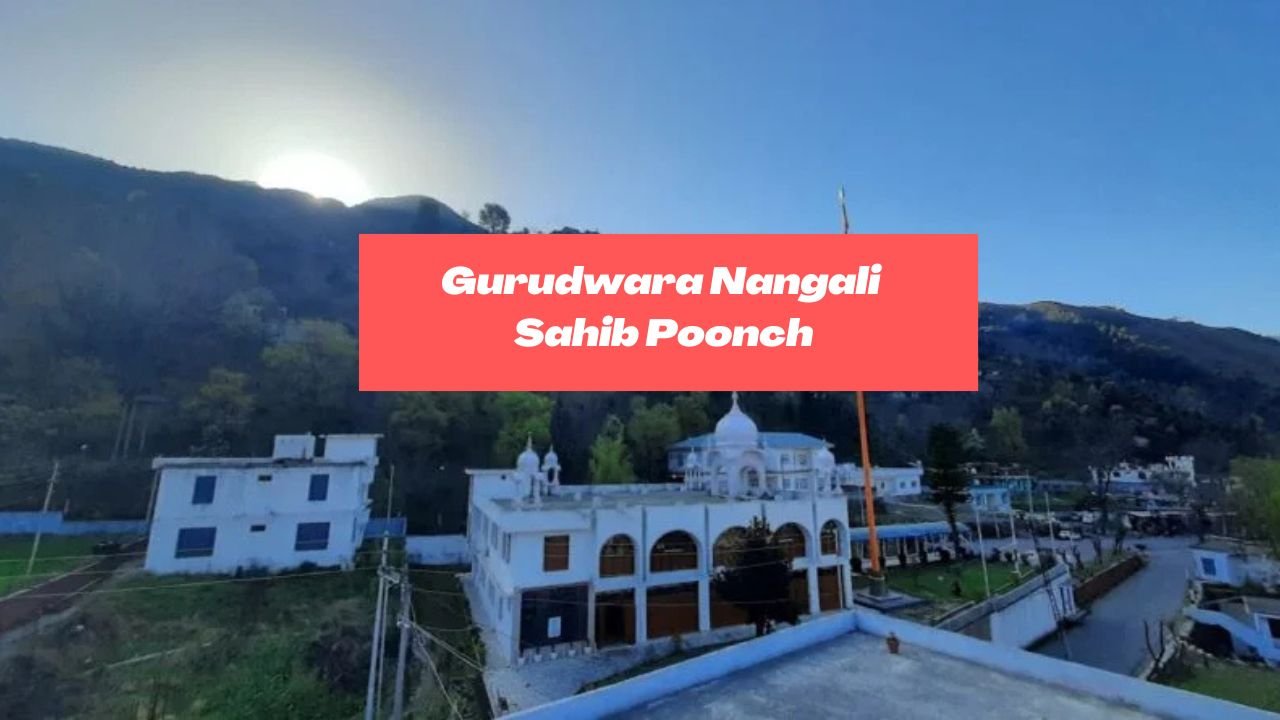
Nestled amid the serene Doda mountain range, on the peaceful left bank of Durga Nadi (Drungli), stands Gurudwara Nangali Sahib, one of the most revered Sikh shrines in Jammu & Kashmir. Located barely four kilometres from Poonch town, this holy site is not just a place of worship but a living symbol of spiritual strength, sacrifice and communal harmony that has endured for more than two centuries.
From Bowli to Nangali Sahib: Birth of a Sacred Land
More than 200 years ago, a towering spiritual figure of his time, Sant Thakur Bhai Mela Singh Ji (Fourth successor of Sant Bhai Feru Singh ji) , chose this tranquil spot for meditation and devotion. At that time, the village was known as Bowli. With the establishment of Dera Sant Pura Nangali Sahib and the Gurudwara, the village gradually came to be known as Nangali Sahib, a name now etched deeply in Sikh history.
Today, the sprawling Dera Nangali Sahib complex houses:
- The Samadhi of Sant Thakur Bhai Mela Singh Ji
- Tapo Asthan (Meditation Cave)
- A majestic three-storey Gurudwara Sahib with nearly 70 rooms
- Langar Hall, Rest House and First Aid Centre
- A newly constructed Gurudwara in memory of Mahant Bachitter Singh Ji
A Beacon of Sikhism in Jammu & Kashmir
Historically, Gurudwara Nangali Sahib has played a pivotal role in spreading Sikhism across Jammu & Kashmir. The shrine commands immense reverence among Sikhs, while also attracting Hindu and Muslim devotees, reflecting the region’s rich tradition of interfaith harmony.
Every year, on the auspicious occasion of Baisakhi, thousands of devotees gather here. After Akhand Path, Shabad Kirtan, Ardas, Bhog and Langar, the religious congregation transforms into a vibrant Mela, marked by spiritual fervour and cultural celebrations.
One of the major highlights is Gatka, the traditional Sikh martial art, where young Sikhs dressed in religious attire showcase breathtaking sword skills, drawing massive crowds.
Roots Linked to Guru Gobind Singh Ji’s Mission
According to Tariq-e-Aqwam-e-Poonch by Mohammad Din Foaq, after the establishment of the Khalsa Panth, Guru Gobind Singh Ji Maharaj deputed Sikh missionaries to spread Sikhism in Kashmir and Pothohar regions.
Among them:
- Sant Bhai Pheru Singh Ji worked in Hazara
- Bhai Punjab Singh Ji established a Dera in Muzaffarabad
- Sant Bhai Rocha Singh Ji, a disciple of Bhai Pheru Singh Ji, was assigned Poonch
Sant Bhai Rocha Singh Ji laid the foundations of Sikh preaching in the region and later appointed Thakur Bhai Mela Singh Ji as his successor in 1803 AD, formally installing him as Mahant on Baisakhi.
Foundation of Dera Nangali Sahib
Finding Poonch town unsuitable for prolonged meditation, Sant Thakur Bhai Mela Singh Ji moved towards Bowli. Captivated by the scenic and peaceful banks of Durga Nadi, he established his Dera here in August 1803 AD. With the approval of then Poonch ruler Gujjar Wazir Ru-Allah-Khan Sangu, the Dera soon became a spiritual nucleus.
The shrine also received reverence from historical rulers. Maharaja Ranjit Singh visited Nangali Sahib in 1814 AD, while Raja Gulab Singh, later Maharaja of J&K, paid obeisance during his Poonch visit. Several villages were attached to the shrine to ensure uninterrupted Guru Ka Langar.
Trials, Triumphs and Reconstruction
Maharaja Ranjit Singh visited Gurudwara Nangali Sahib in 1814 and was impressed very much. He attached an estate with the Gurudwara sahib. He again attached a four villages with the Gurudwara sahib in the year 1823.
After Sant Thakur Bhai Mela Singh Ji’s passing in 1854 AD, the Dera was led by a succession of devoted Mahants.
The most testing phase came during 1947, when the shrine was burnt during tribal attacks. With the donations and efforts of Sangat and efforts of Mahant Bachitter Singh Ji, despite displacement and loss of land due to land reforms and floods, ensured that Langar never stopped. His unwavering faith led to the construction of the iconic three-storey Gurudwara building in 1966, at a cost of ₹15 lakh — a landmark religious structure in the Poonch region.
A Legacy Continued: Education & Social Reform
After Mahant Bachitter Singh Ji’s demise in 1991, leadership passed to Mahant Bhai Manjeet Singh Ji, who expanded the Dera’s role beyond spirituality. Under his guidance:
- A new Gurudwara was built in memory of his predecessor
- Agricultural land was purchased to sustain Langar
- Engineering College and B.Ed. College were established in Jammu
- Plans for a Medical College for students from remote and border areas are underway
His contributions have transformed Dera Nangali Sahib into a centre of education, social reform and community upliftment.
How to Reach Gurudwara Nangali Sahib, Poonch
By Air / Rail:
The nearest major air and rail hub is Jammu. Travelers can fly to Jammu Airport (IXJ) or reach Jammu Tawi Railway Station, which is well connected to major cities across India.
By Road to Poonch:
From Jammu, Poonch town is approximately 240 km away. Visitors can hire a taxi, use private vehicles, or take JKSRTC / private buses. The journey passes through scenic mountain routes and usually takes 6–8 hours, depending on road and weather conditions.
From Poonch to the Shrine:
Gurudwara Nangali Sahib is located about 4 km from Poonch town, on the banks of the Drungali (Durga Nadi). The shrine is easily accessible by local taxis, auto-rickshaws, or private vehicles and is well signposted from Poonch city.
Tip: Roads in the region are best traveled during daylight hours, especially in winter or monsoon seasons.
Today, Gurudwara Nangali Sahib, Poonch, stands as a timeless reminder that faith, when combined with service and education, can shape societies and inspire generations. It remains not just a sacred shrine, but a living institution of spirituality, unity and hope in Jammu & Kashmir.