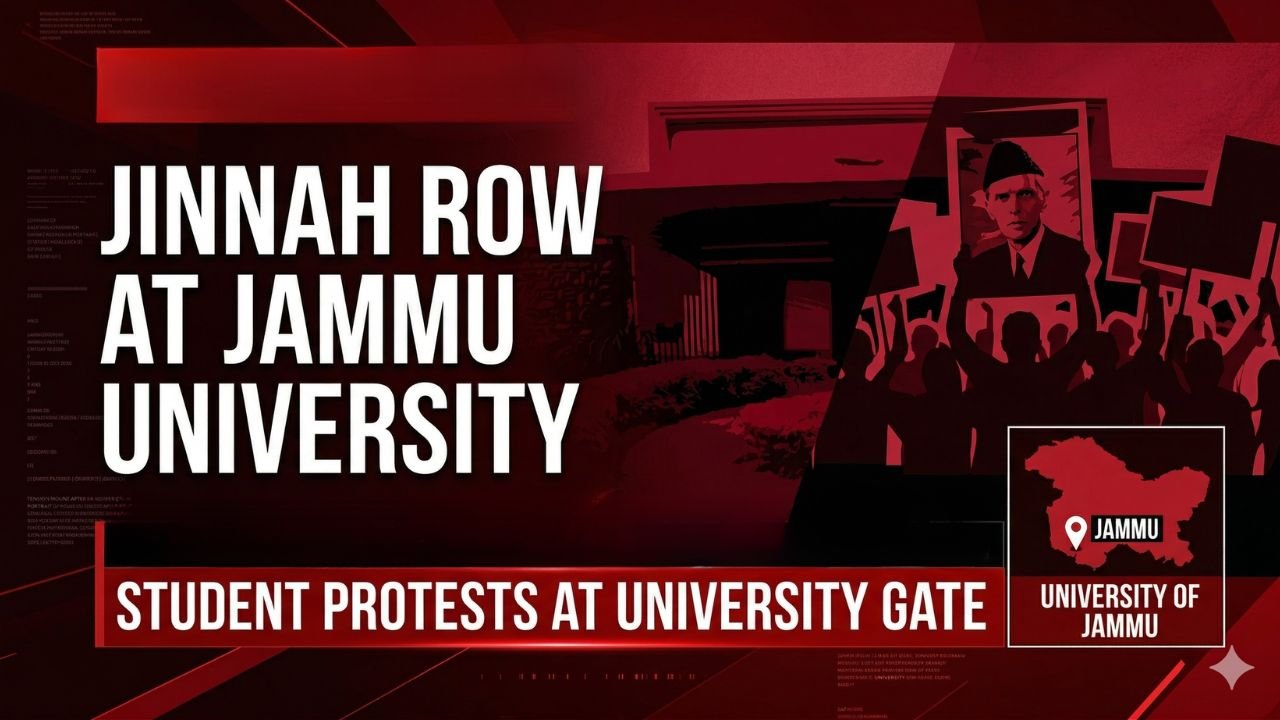
The recent controversy at University of Jammu has ignited a sharp debate across academic, political, and public spheres. At the center lies the inclusion of a chapter on Muhammad Ali Jinnah in the university syllabus—triggering intense scrutiny, ideological clashes, and demands for immediate review.
The controversy stems from a curriculum component reportedly featuring Muhammad Ali Jinnah within M.A. Political Science syllabus as a political science or history framework.
Key Context:
- The chapter is part of a broader academic study of South Asian political history.
- It examines the role of Jinnah in the partition of India.
- It includes analysis of ideological movements, nationalism, and constitutional developments.
The inclusion itself is not new in academic circles; however, its presence in a sensitive regional context has intensified reactions.
Why Did the Jammu University Jinnah Chapter Controversy Erupt?
The issue escalated rapidly due to a combination of political sensitivity and regional sentiment.
Core Triggers:
- Public objection to teaching about Jinnah in an Indian university.
- Concerns over “glorification” versus “critical academic analysis.”
- Political mobilization around nationalist narratives.
Immediate Fallout:
- Protests from student groups and political organizations.
- Calls for removal of the chapter from the syllabus.
- Administrative pressure on university authorities.
University’s Response: Committee Formed for Syllabus Review
In response to growing tensions as per online media repots, University of Jammu constituted a high-level committee to examine the syllabus.
Committee Objectives:
- Review the academic relevance of the chapter.
- Assess whether the content aligns with educational goals.
- Ensure balanced historical representation.
Institutional Position:
The university clarified that:
- The syllabus is designed strictly for academic purposes.
- No ideological endorsement is intended.
- The review aims to maintain academic integrity and public confidence.
Reported by Indian Express, Head of the Political Science Department at Jammu University, Baljit Singh Mann, however, defended the syllabus, saying the inclusion of Jinnah and other thinkers is purely academic and consistent with curricula followed by universities nationwide, as well as UGC norms.
Political stakeholders across Jammu and Kashmir have expressed divergent views.
Strong Opposition:
- Several leaders demanded immediate removal of the chapter.
- Concerns raised about influencing young minds.
Moderate Voices:
- Some called for context-based teaching instead of removal.
- Emphasis on balanced historical narratives.
Academic Defenders:
- Scholars defended the inclusion as part of legitimate historical study.
Why Jinnah Remains a Sensitive Topic
Muhammad Ali Jinnah remains one of the most debated figures in Indian history.
Key Reasons:
- Central role in the partition of India in 1947.
- Association with the creation of Pakistan.
- Emotional and political legacy affecting India-Pakistan relations.
For regions like Jammu, which have witnessed prolonged geopolitical tensions, such topics carry additional sensitivity.
The controversy at University of Jammu has turned into a high-stakes issue, blending education with politics. The committee’s decision will be crucial in shaping both the university’s academic direction and the broader discourse on sensitive historical topics in India.