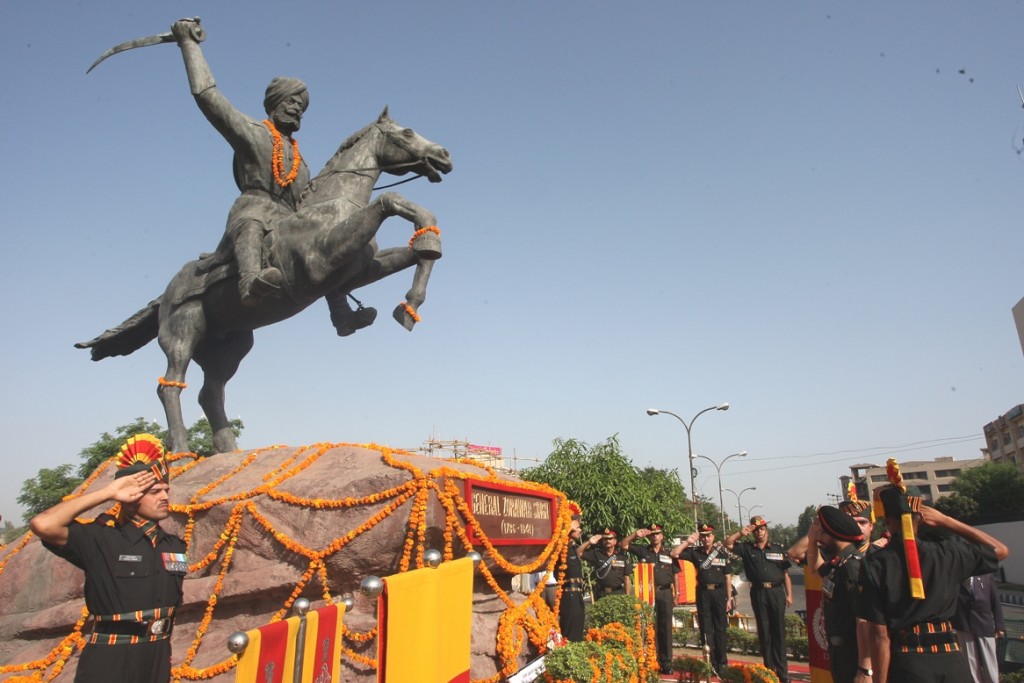
Most people know General Zorawar Singh for his sweeping conquests across Ladakh, Baltistan, and Western Tibet. Few know the quieter, hidden moments that shaped those victories. And fewer still remember that his journey ended far from home, in the icy battlefield of Toyo near Taklakot, where he attained martyrdom on December 12, 1841.
Every year, Dogras observe this day as his Punyatithi, honouring the warrior who fought at impossible altitudes and earned reverence even from his enemies.
But long before that final battle, another story unfolded — a lesser-known moment that changed the course of Himalayan history.
To recount General Zorawar Singh’s achievements, one must look east of Kishtwar, towards the snow-clad mountains and valleys of the upper Himalayas. Several principalities in this region were tributaries of Tshepal, the Gyalpo (King) of Ladakh. In 1834, one such ruler — the Raja of Timbus — sought assistance from Raja Gulab Singh against the Gyalpo. Recognizing a strategic opportunity, Raja Gulab Singh ordered his capable commander, General Zorawar Singh, to march into Ladakh and bring it under Dogra influence.
The Dogra General had long awaited a chance to prove his military prowess. The Rajputs of Jammu and Himachal were traditionally exceptional mountain fighters, and Zorawar Singh was no exception. He crossed the treacherous mountain ranges with ease and advanced into Ladakh through the Suru River valley, where his 5,000-strong force defeated a local army under General Mangal. By mid-August 1934, the Dogras had established control over the western province of Purig. Destroyed a key Ladakhi fort at Sanku. His soldiers then crossed freezing rivers using blown-up sheepskin rafts, to capture the fortress of Pashkyum.
After a short halt to reorganize and strengthen his troops, Zorawar Singh resumed his march toward Leh. In response, the Gyalpo dispatched General Banko Kahlon to sever the Dogra commander’s lines of communication. Anticipating the threat, Zorawar Singh swiftly withdrew to Kartse, where he safely quartered his troops through the harsh winter.
When spring arrived in 1835, the Dogra commander launched a decisive campaign, defeating the large army led by General Kahlon. He then advanced triumphantly to Leh. The Gyalpo, struck with panic, sued for peace and personally negotiated with Zorawar Singh for nearly four months before an agreement was reached.
Under the settlement, the Gyalpo was allowed to retain his title, but Ladakh became a vassal state of the Dogra Kingdom. As part of the terms, Ladakh was required to pay a war indemnity of Rs. 50,000 to Jammu and provide an annual tribute of Rs. 20,000.
This small but extraordinary chapter shows why Zorawar Singh was revered as the “Napoleon of the East.”
His courage could cut through fear,
His strategy could cut through armies,
And his will could cut through mountains.
His legacy stretches from that winter night in Kartse to his final breath in the Battle of Toyo, where he attained martyrdom on 12 December 1841.
Today, Dogras honour him every year on his Punyatithi, remembering the general who conquered Ladakh and Baltistan for the Dogra kingdom and won respect even from those he fought.